Guns are dangerous, ‘mkay?

I’m going to do a piece or two on beginner guns, but even before that, gun dangerousness. Yes, guns are dangerous. They are intended to be so. That is their original design principle. So, “gun safety” is a bit misleading.

A gun is a force projector. It is the evolutionary result of throwing stones, throwing spears, shooting arrows. It is designed to inflict potentially lethal force against other beings, human and otherwise. All the other uses of guns, plinking, target shooting, trap/skeet, all are secondary to the basic purpose of a firearm. With that in mind, let’s examine how we can control that force.

First, “The Four Rules”. When followed religiously, they ensure that the projection of that force does not result in unintended results.

  1. Every gun is loaded. Treat every gun that way.
  2. Do not let the barrel of the gun “cover” (point at) anything you are not willing to destroy.
  3. Do not put your finger on the trigger until you are on target and ready to shoot.
  4. Know what your target is. And what’s beyond it.

Discussion:

  1. When handling any firearm, if you treat it as if loaded, you won’t do stupid unloaded gun stuff – looking down the barrel, waving it around, doing quick draws. How many times have you heard, “But I didn’t know it was loaded!”
  2. This means always pointing your firearm in a safe direction. Good example – if you are on the firing line and your gun is pointed toward the ground, is it a safe direction? Maybe. But next time, take a look at where your feet are. Is your gun covering your toes? Another example – some shotgunners have special shoes made with a leather piece on their toe so that they can rest the barrel there between shots. AYFKM? Even shooting bird shot, a negligent discharge will go right through that resting point.
  3. As every veteran heard in basic training, “Keep your booger hook off the bang switch!” Literally, do not let your finger come in contact with the trigger until you are pointing at the target and you are beginning the trigger press. This is sometimes hard to do in practice. Think, most every gun is designed to be comfortably held in the hand and the trigger finger naturally wants to go inside the trigger guard. This is why you really do not want to try to catch a gun if you drop it. Yep, you caught it and it didn’t get dinged or dirty. Nope, you caught it perfectly and contacted the trigger just enough to set it off.
  4. Sure, you know you pinned a target to the tree. Have you considered what happens if you miss? Or if the bullet is not stopped by it? Where will that bullet end up. OK, is that a deer or Farmer John’s red heifer? Do you know that a little itty bitty .22 round can travel 1500 – 2000 yards? That would be over a mile if you haven’t done the math. So make sure that so,etching will backstop your round.

Thinking about it, if you follow these rules, you will likely never have a negligent discharge. Nope, there are no “accidental” discharges.

When I shoot with someone I have never shot with before, I always go over The Four Rules. If they know anything about shooting, they never complain.

Next up, Guns for Beginners. BTW, beginners never set hands on a gun with me until they repeat and explain The Four Rules to me.

Now that’s better.

Another overnight soak, a bit more brushing and swabbing. Much cleaner.

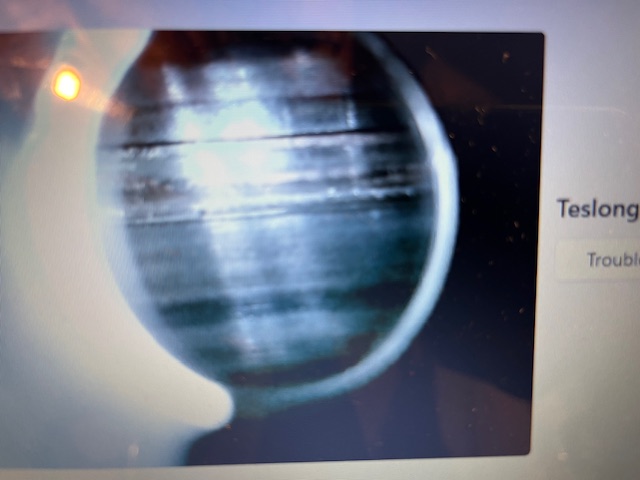
However . . . I think all the lines ‘n stuff are machining marks. They run the length of the barrel each side of a land. The carbon sure has a place to latch onto.

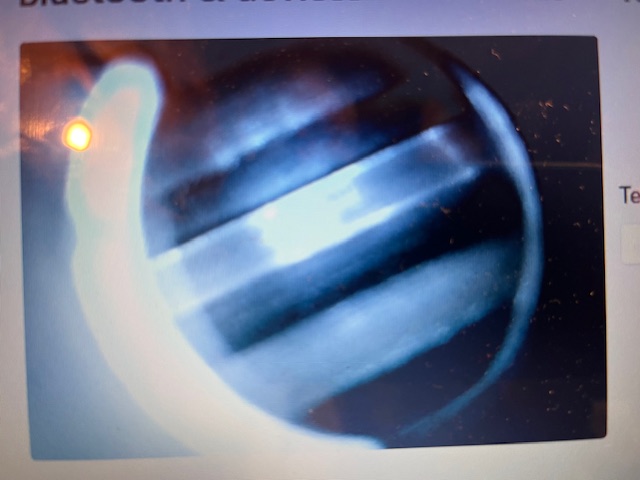
But here’s an interesting pic. Inside the gas port you can see the adjustment mechanism.

So, earlier today I’m looking at these pics and Mrs. Red says, “Are those from your colonoscopy this morning?”

As long as we are going there . . .

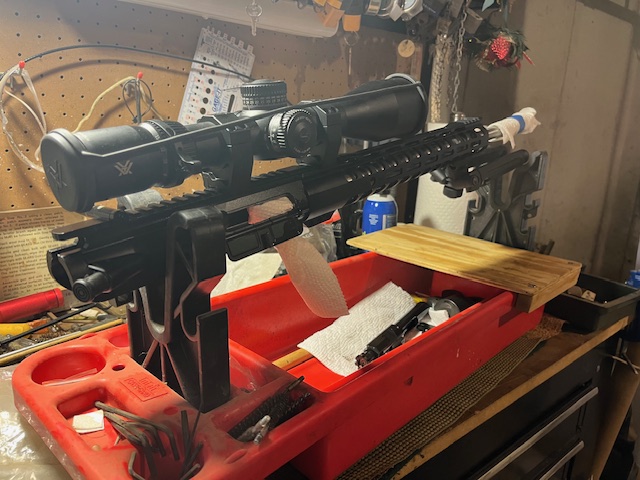
Since the scope was still out and I’d never looked inside the AR-10 barrel:

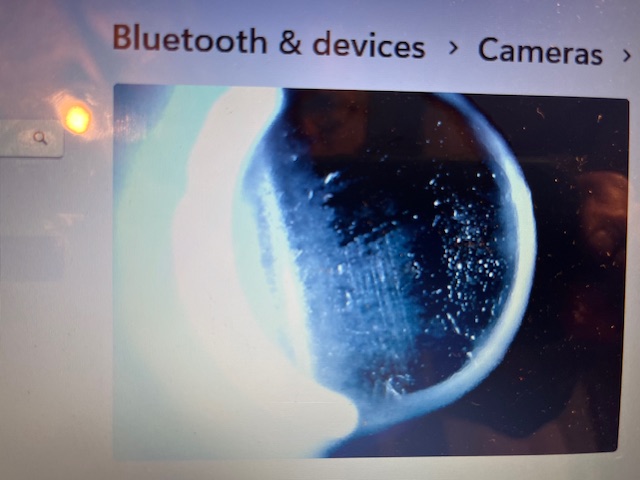
Clearly some carbon fouling down next to the lands and a bit of copper on them.

Ramps to the lands are dirty but not much in the way of erosion.

Lots of carbon at the mouth and inside the chamber. Not surprising with a direct impingement gas system.

Gas port is clear, maybe a little wear or buildup on the left.

Time for some Wipe-Out!

Post-Rifleoscopy

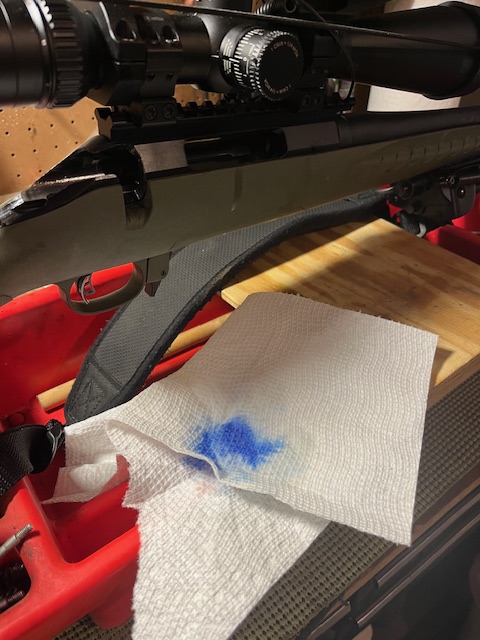
The “After” pictures. Remember, if you see blue, it means copper fouling.

Shiny clean lands:

End of chamber, ramping up to lands. Not much throat erosion.

And crown at end of barrel:

3,000 plus rounds. Wipeout for the win.

What the heck is an “Aspirin Shoot”?

Well, d’oh. You get up early in the morning and scout those little rascals and blast the heck out of them . .

Really, though, you have to get up pretty early in the morning to claim your favorite shooting table at the club. The rock solid one that gives you the best angle on those little devils.
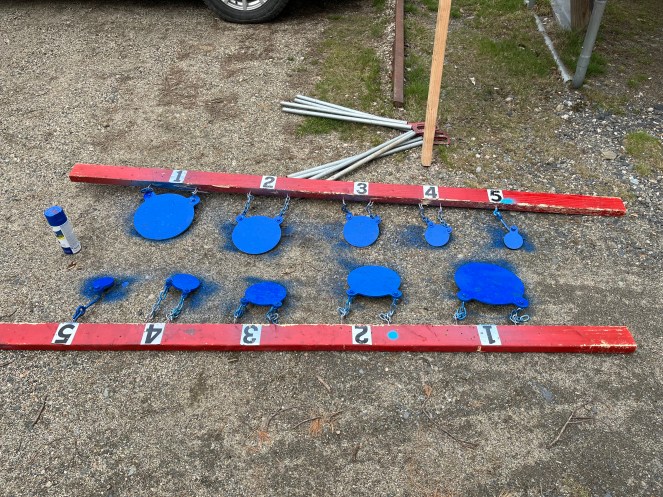
Here is the course of fire: Aspirin at 50 yards. Tums at 100. Know Your Limits steel at 150. Same at 200. .22 caliber only, but any rifle you want. Bipod and rear bag only.

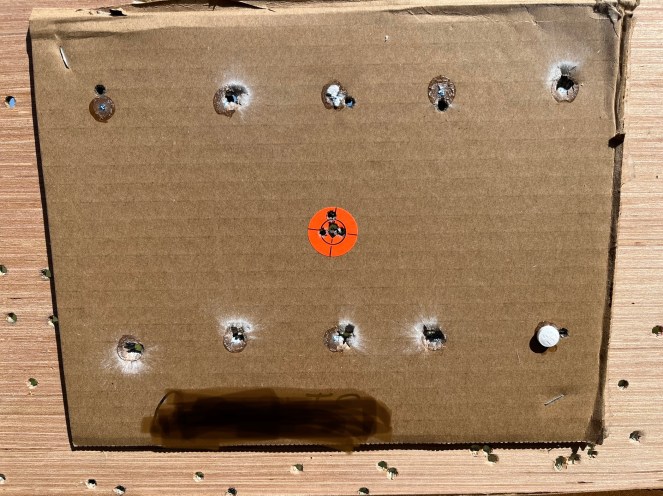
10 aspirin on your individual cardboard target. One fluorescent sighter target. You may take up to 10 sighter shots, but once on the aspirin, you cannot go back. One shot per aspirin. If the round touches any part of the aspirin it is a hit. Yes, black wax streak on the side is a hit. Max score of 10.

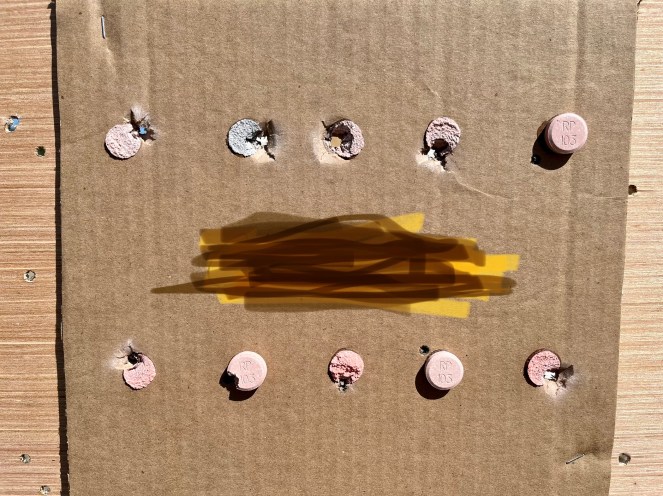
Same thing at 100 yards with Tums. Word to the wise – this is the hardest stage.

At 150, the 5 hanging KYL targets start at 8” diameter and go down to 2.5”. You must hit each target before going on to the next. Once you hit the smallest one, you keep shooting at it.

200 yards is the same. So max score possible is 40 points. On a great day the winning score is 32-34 points. On a cold winter day in blowing snow, low 20s will win.
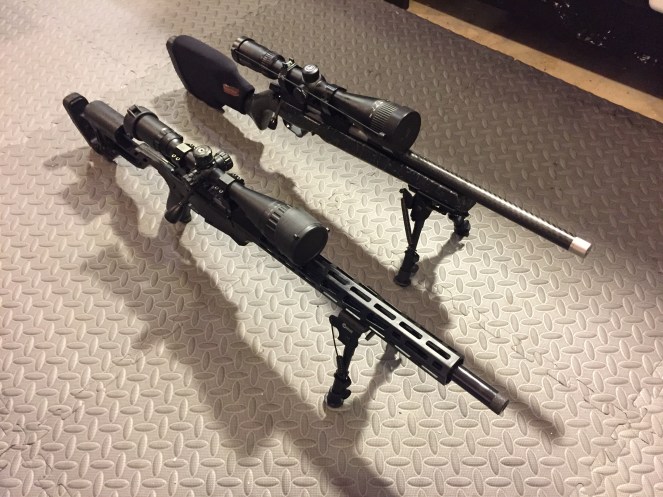
So what rifle do you use? At least at our club, everyone started out with Ruger 10-22s, and shot CCI Standard. But is wasn’t long before ammo changed to Eley, SK, Wolf, and rifles changed to CZ, Ruger

Precision Rimfire, and the like. My own upgrades were the Christiansen Ranger and the Ruger Precision Rimfire.

Let’s take a look:

This is the best I’ve shot. 9/10. Pretty sure won that day with a 34.

Tums are tuff. At 100, wind really kicks in.

An 8 will keep you in the running.

This is what you are shooting at.

And it looks like this:

Some people say that .22 at 200 yards is similar to large caliber at 1000. I tend to agree. The .22 LR is an anemic round; it gets pushed around by the wind a lot. But it’s been around for a hundred and fifty years and is arguably the most popular caliber. It is hard to shoot well at distance.

But would you stand there and offer to be a target? I don’t think so.

Accurizing the Ruger 10-22, Part 5

A quick recap to see how we got here:

  1. Barrel free-floated.
  2. Receiver bedded.
  3. Pillar and new escutcheon bedded in place.
  4. New trigger group installed.
  5. New action screw to receiver torque-tested.
  6. Receiver tune-up parts installed.

At this point I’ve put about $150.00 and many man-hours into the project. My initial conclusions were that I had increased accuracy somewhat, and that it was a fun project. But final testing after finding the proper torque on the pillar-bedded rifle showed a significant improvement – from over an inch at 50 yards to just over 1/2”. For a stock 20 year-old Walmart-purchased Ruger 10-22, I’ll take that.

However.

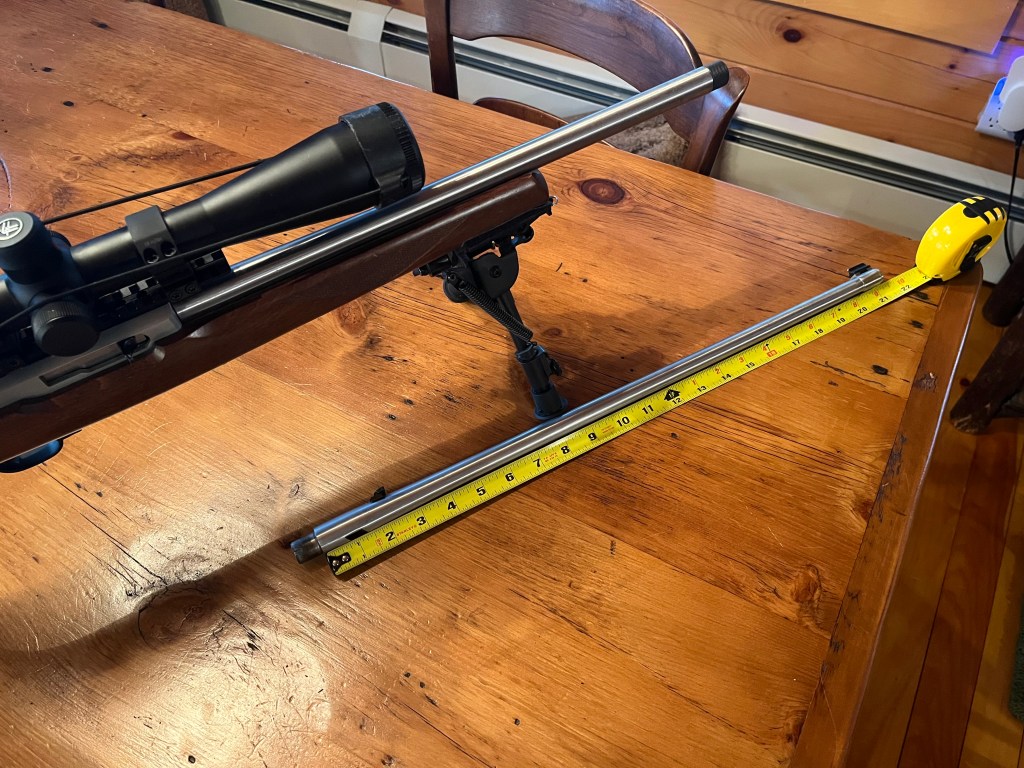
Before I had figured out the absolute criticality of torque on the action screw, I was getting such inconsistent results that I thought that I’d just order a new barrel. I also wanted to shoot suppressed; therefore it needed to be threaded. Off to Green Mountain.

Now, the original barrel is stainless, 21”. There is constant discussion about the perfect .22 barrel length – 16, 18, 22”? My Aspirin Shoot rifles are 16” and are under 1 MOA. I decided to try the Green Mountain stainless, threaded 16.25” bull barrel.

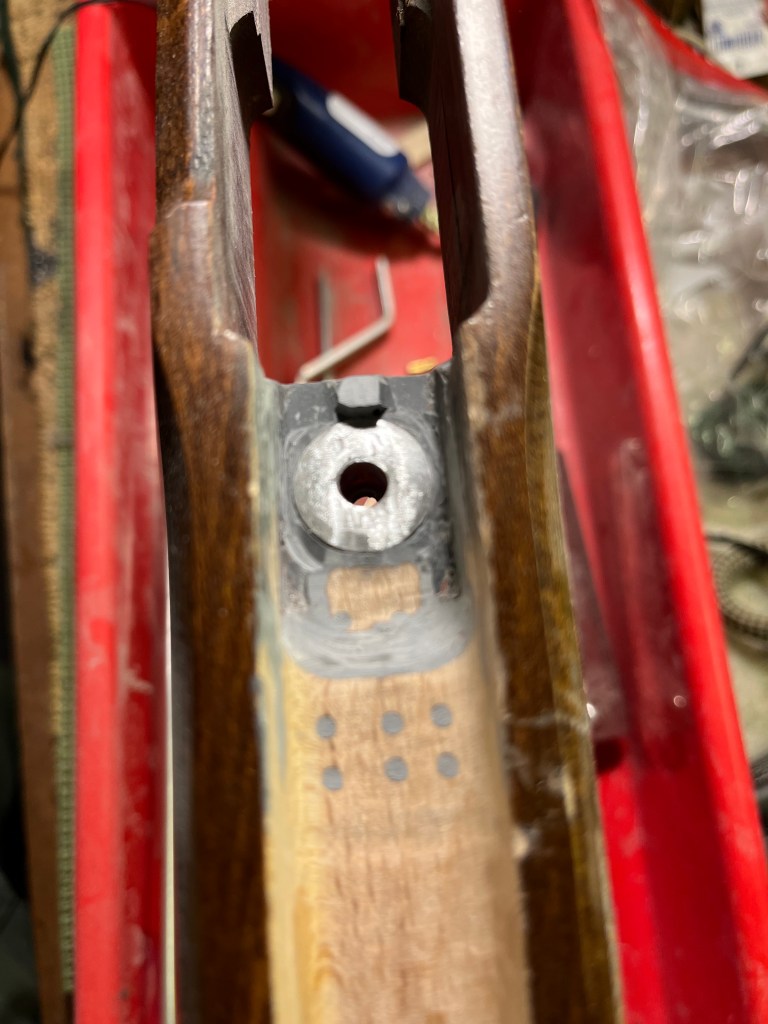
But to install it, we have to change our bedding.

Off to the range!

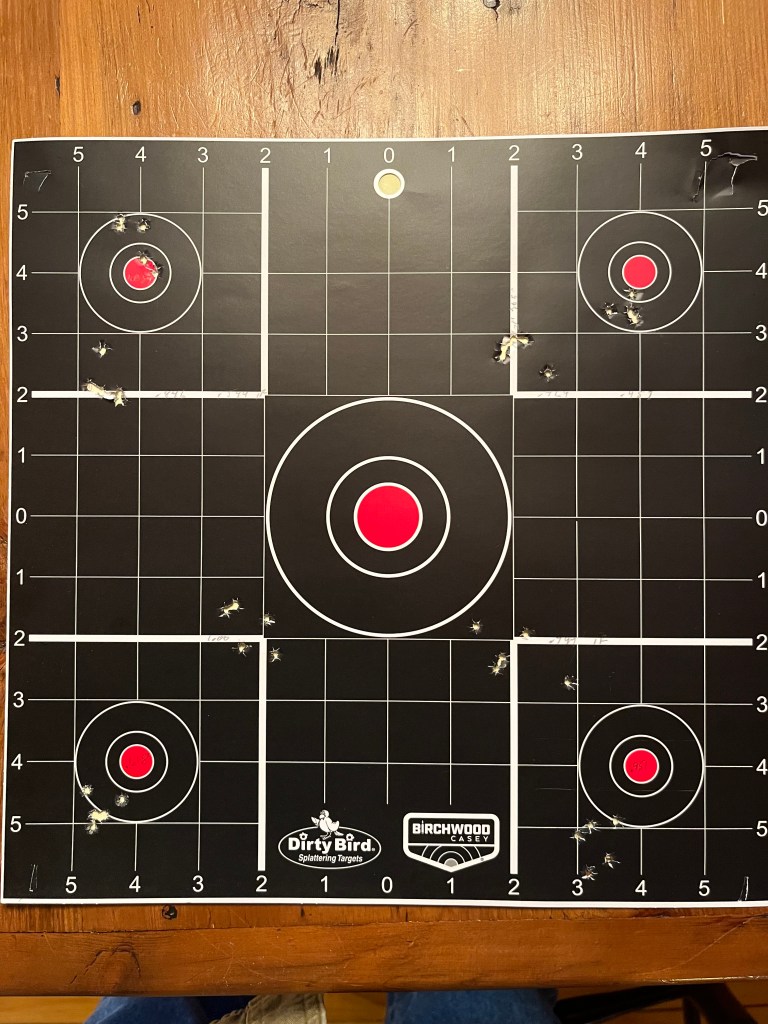
Sorry, the Dirty Bird targets don’t splash with .22. But unsuppressed we get groups of CCI Standard – .846, .544 1 F; Wolf – .457, .346 1 F; SK Rifle Match – .618, 1.00; and CCI Green Tag – .861, .744 1 F.

Suppressed is a little easier to see. We get CCI Standard at 1.126, 1.207 1 F (ouch!); Wolf – .343, .615 1F; SK – .658, .847; and CCI GT – .861, .645 1F.

Looks like my old standby, CCI Standard is out of the running, at least when suppressed? But all in all, the barrel seems to perform very well with some ammo and decently with other. My one regret is that the rifle no longer feeds Eley ammo. That stuff is superb in my Aspirin Shoot rifles. Unfortunately, it has a flat nose with a little cone in the center (patented!). The flat nose catches on the chamber edge and turtles.

And that’s the end of this story. 😇 Don’t worry. There’s more. Much more. Can you say “Aspirin Shoot”?