Having fun with my G21

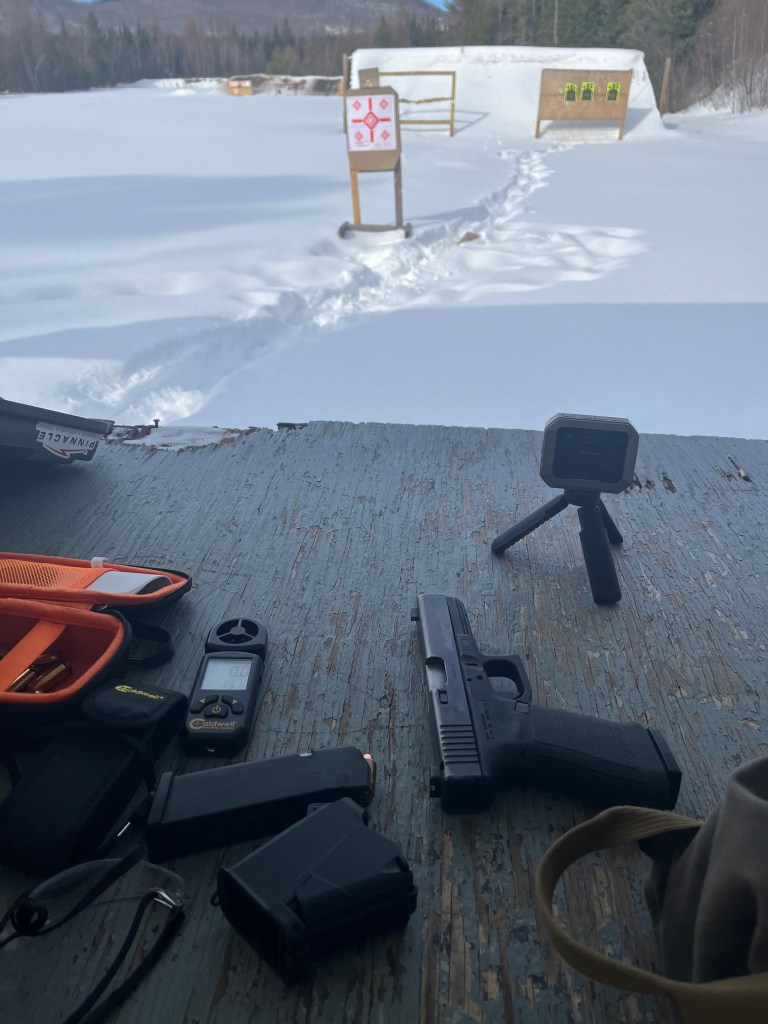
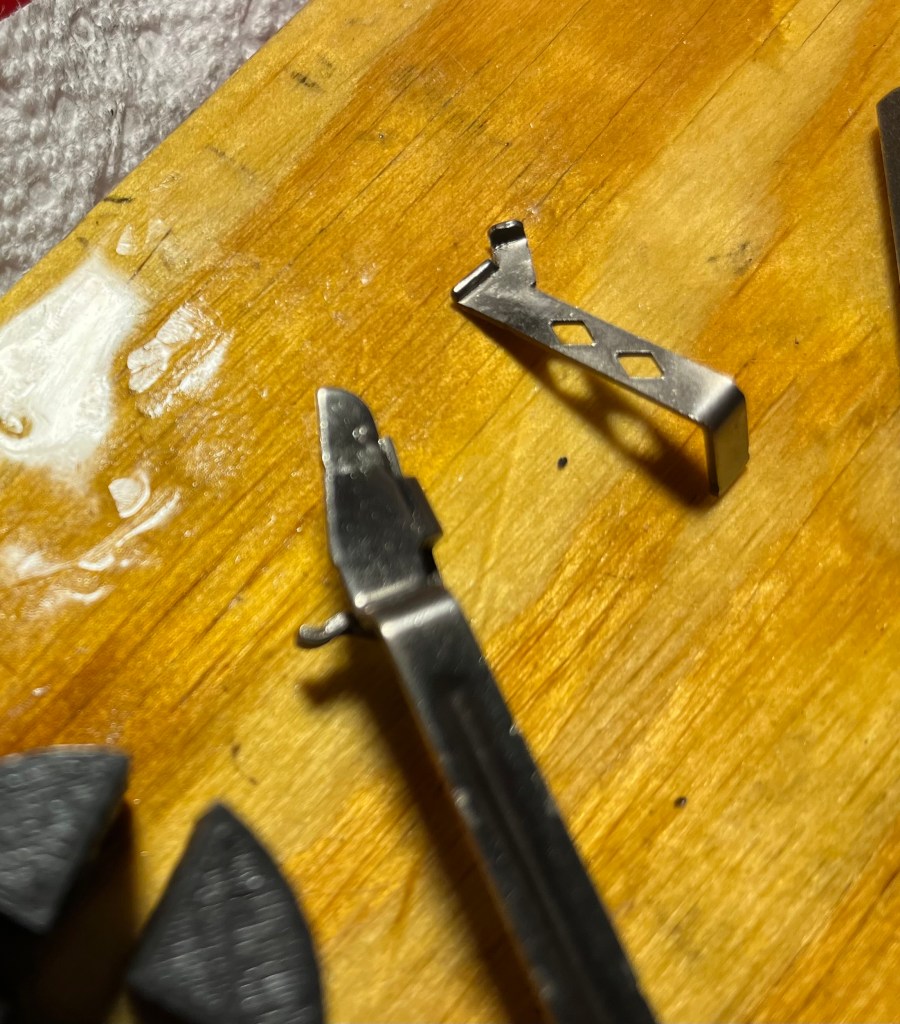
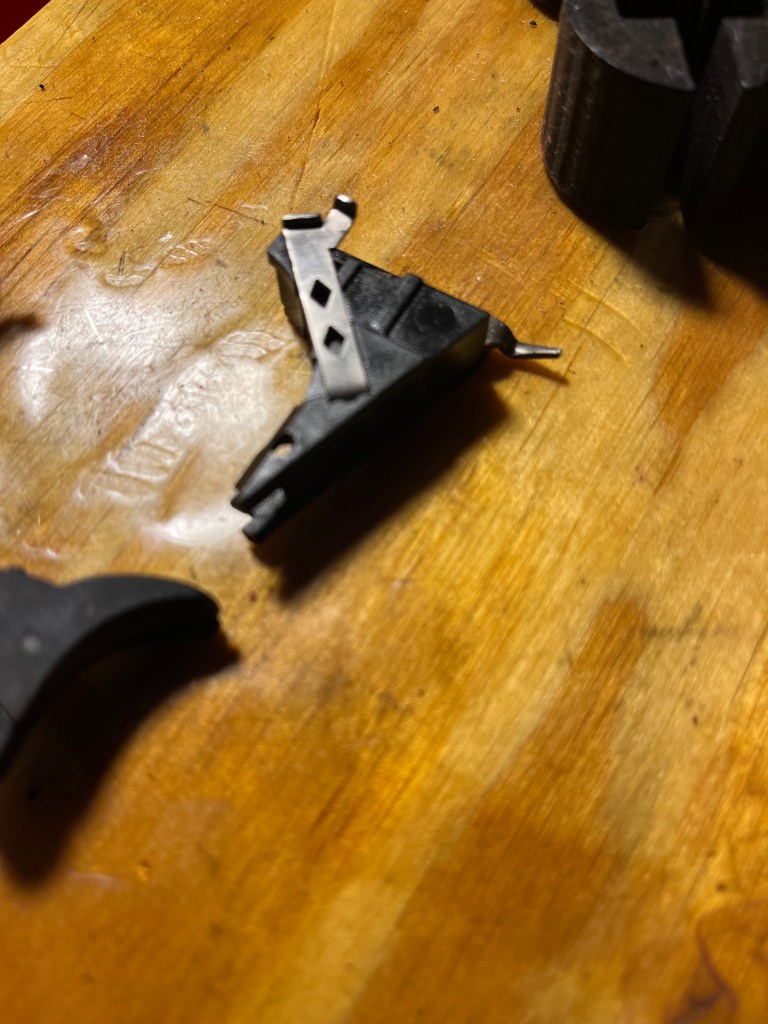
Putting new sights on DILIT’s G44 got me focused on Glocks for a bit. There just may be a little order coming in from Midway. In the meantime, I thought I’d strip the 21 down and do a little cleaning and trigger work. So pop out the three pins and here is what you get:

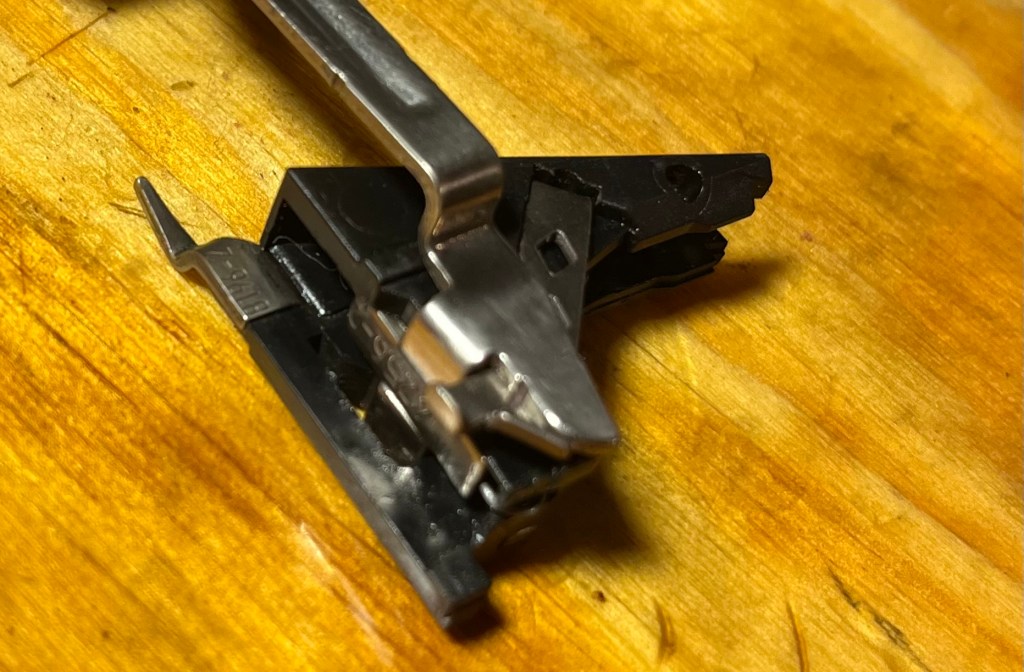
These are the parts we will be polishing to remove friction in the trigger assembly.

Post-polishing:

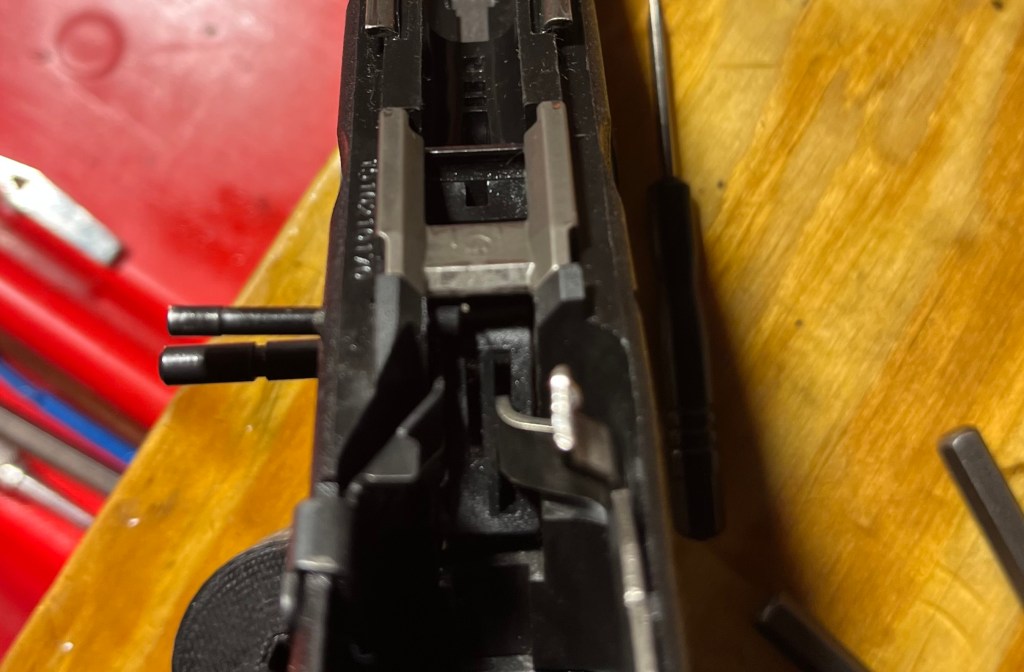
Reassembly:

Where metal meets metal.

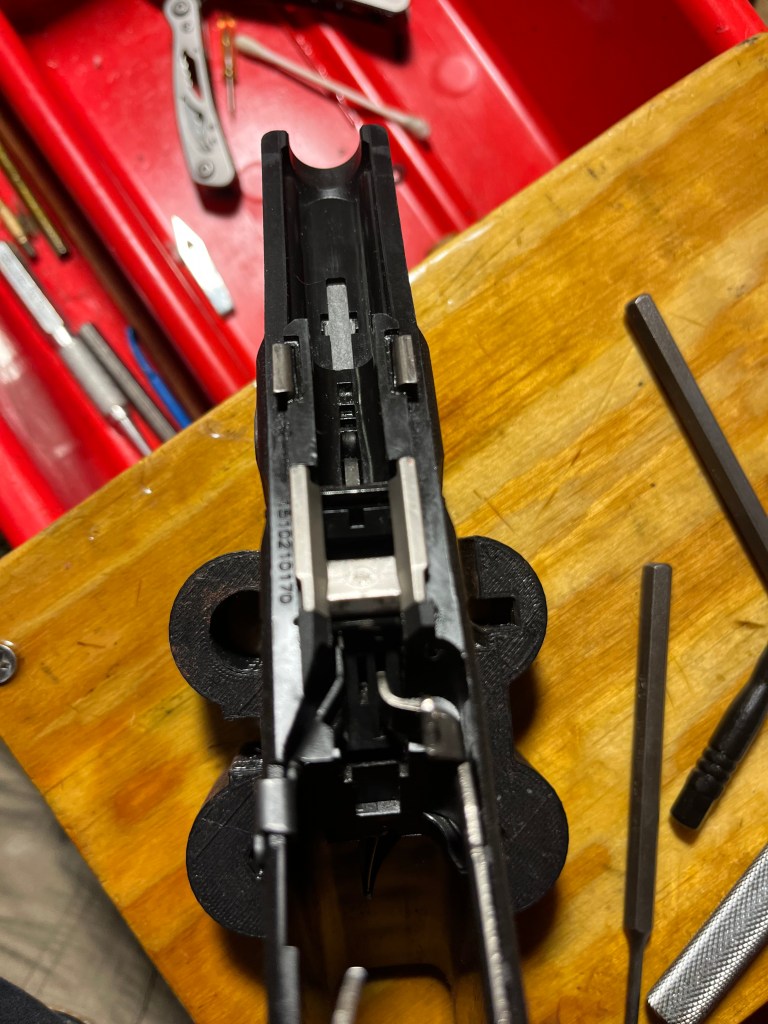
Reassembly into frame:

And, finally, testing trigger pull weight:

4 to 4.25 pounds. If it was just for targets, I’d put a 3.5 pound trigger bar in. Having it go into the carry rotation, I’ll keep it firm.
Yup, winter is for projects. I’ll be looking for that Midway package.

Yes, I have been ignoring short arms.

No, not short arms inspection.

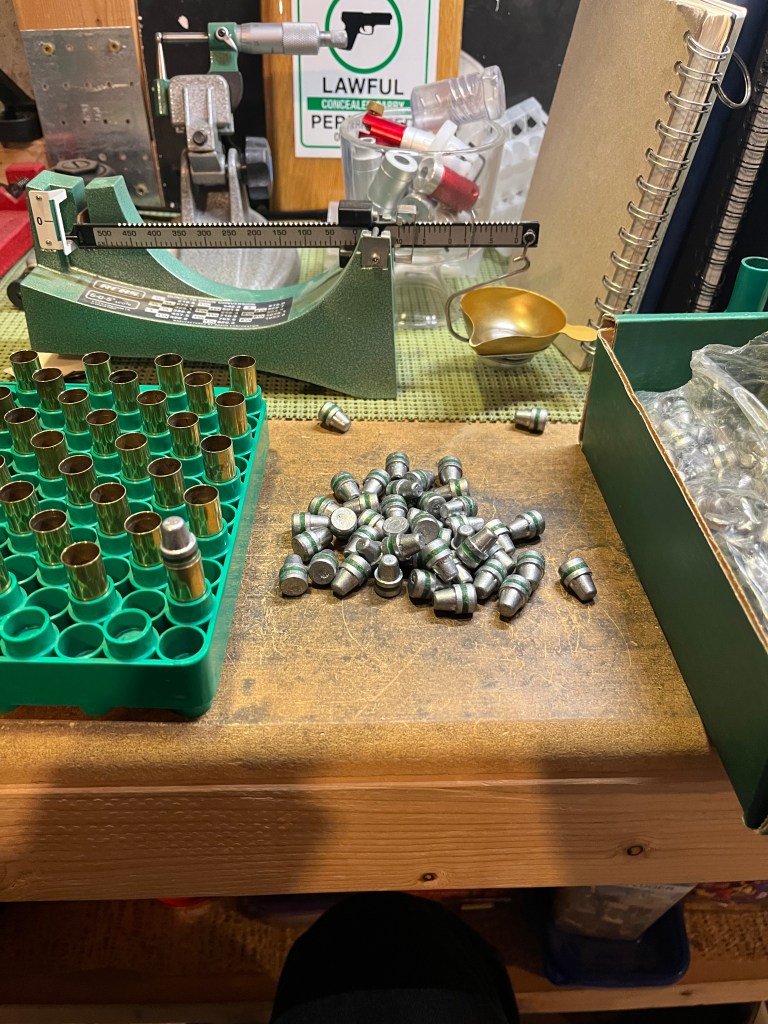
Caliber .45 Automatic Colt Pistol! I hauled out an ammo box of ten 100-rounds plastic boxes and it felt a little light. After full inventory, I discovered a shortage of 200 grain Semi-Wad-Cutters.
Had to switch out the bullet seater to flat nose.

Then, make sure they pass the “plonk” test.

Maybe test it tomorrow?

Back to Winter Shooting

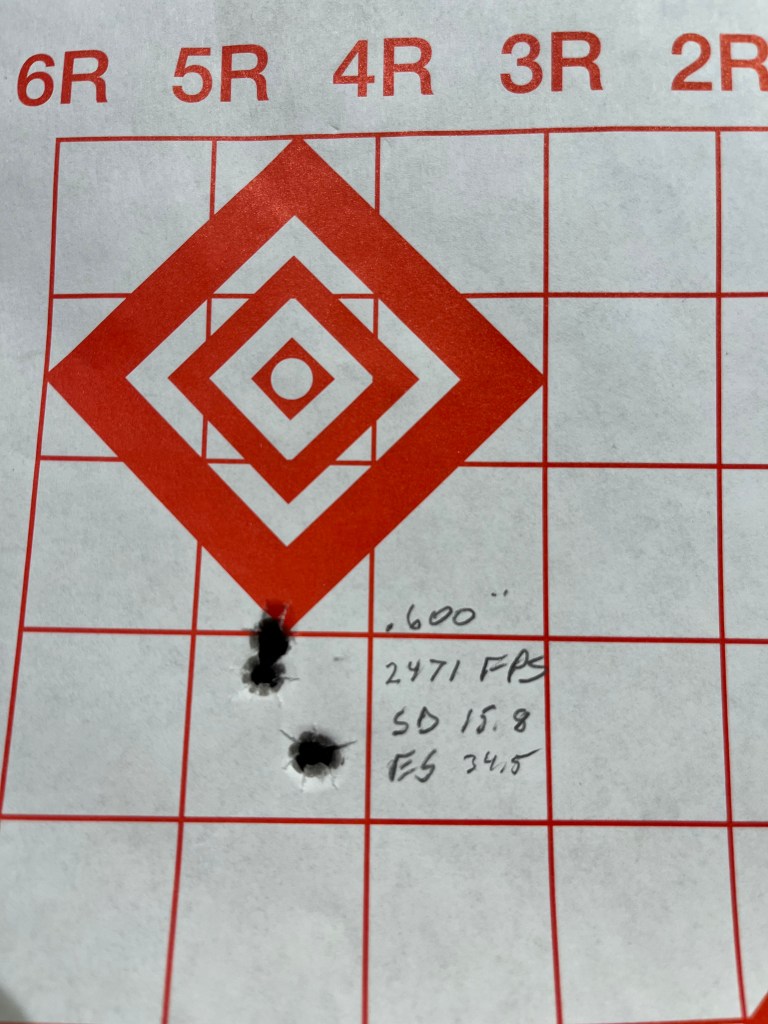
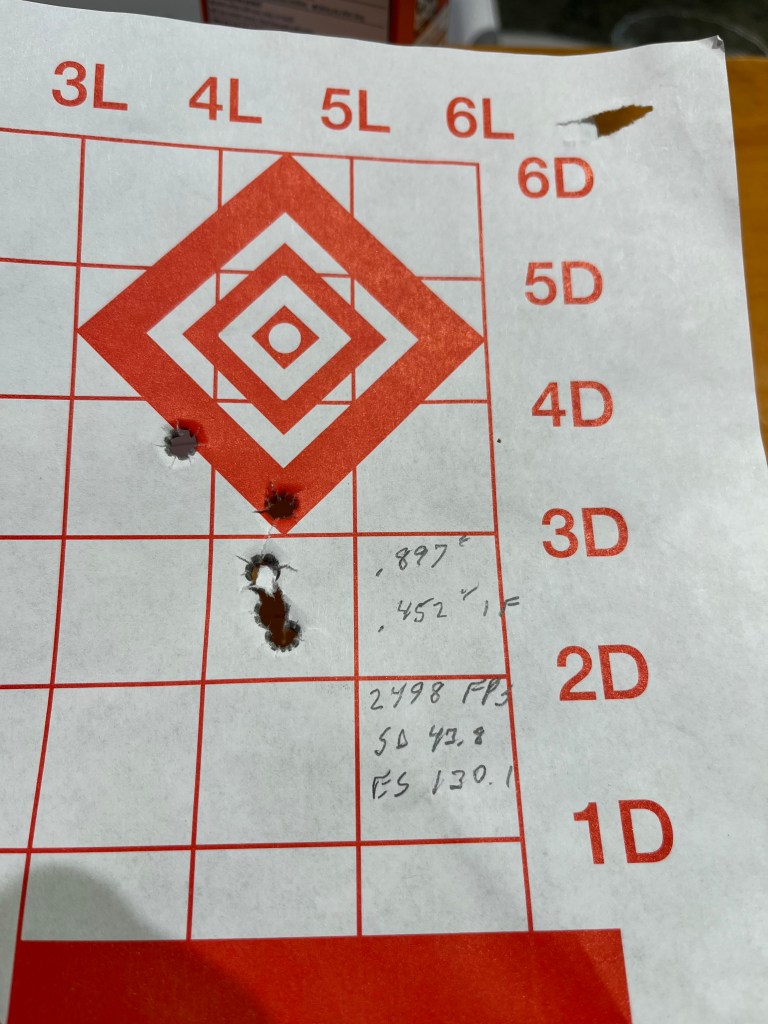
So how did the 156 Bergers shoot? Not bad:

That’s 4 rounds of the 39 g. load. The 40 g. load opened up a bit, but looking at SD and ES, there was at least one bad reload.

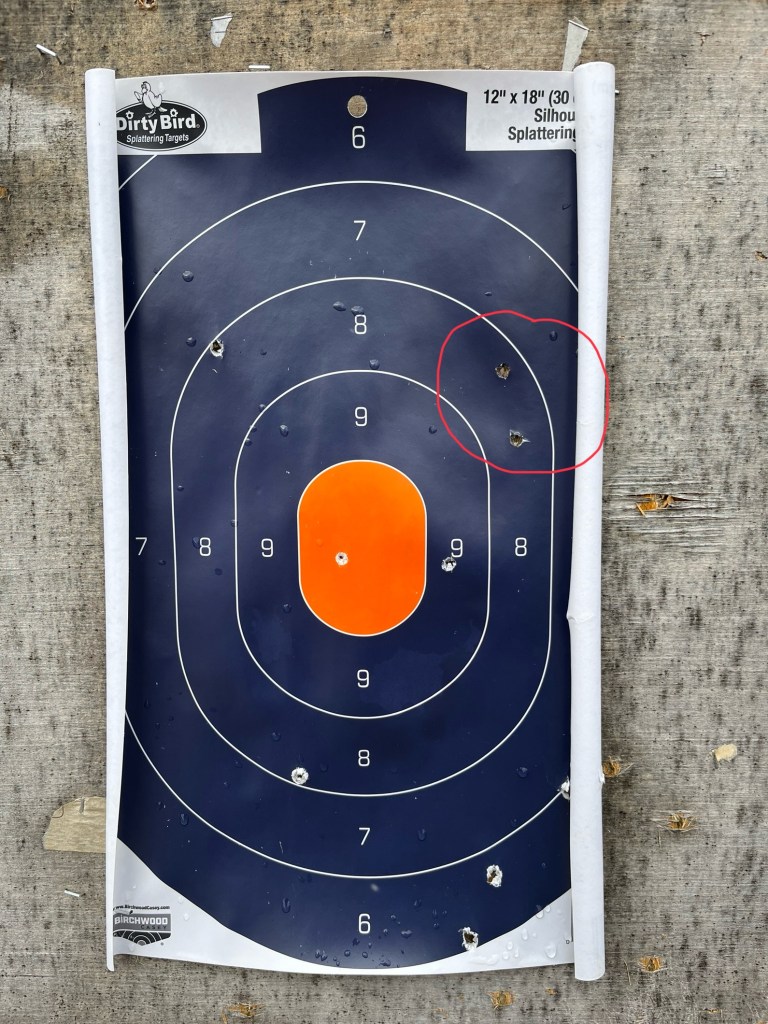
To make the point, I shot my last two rounds of it at a 300 yard silhouette:

Just over an inch. I’ll take that all day long. And when I shot the Dueling tree paddles, the impact was impressive. Nothing like upping the M in the F=MA.

But the best surprise of the day was shooting some Hornady 120 ELD M I had put together a while back:

4 rounds, baby!

🖐🏻 8 👫

Yup, been on a 10-day one. And worse, no shooting! Well, I fixed that today:

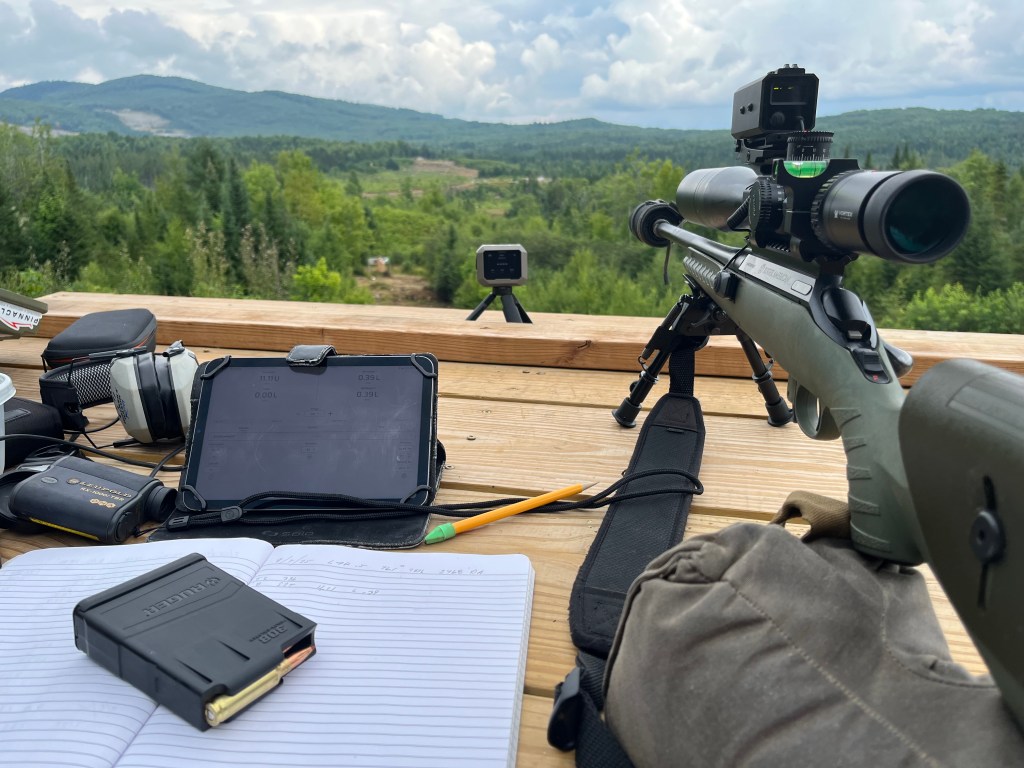
The Long Range just had its annual clearing and I may have been the first one to shoot. 76 degrees, humid, density altitude of 2473’, and a left to right light breeze.

I used the opportunity to wring out the Hornady 120 grain ELDM load. After doing the paperwork and weather, I loaded up and got going.

I’m very pleased with the round. It shot flatter than my Applied Ballistics program predicted by about 2 MOA at distance. Hits at 525, 829, 867, 875, 975 and 1,106. The wind did not seem to affect it any more than my standard 140 g loads.

And, after I was done, I did a drone tour of the newly cleared range. I just might post it soon!

Back to load ladder test

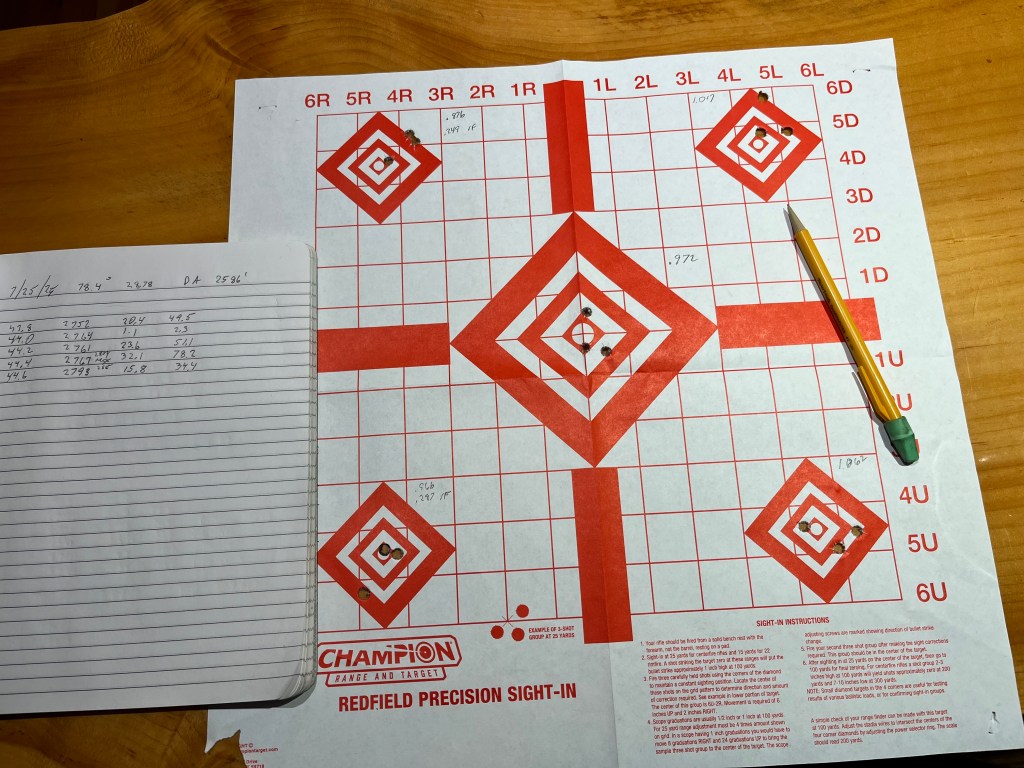
I think I can say I’ve maxed out the Accurate 4350 powder – I’m not going to get more than 2800 fps with the 120 g. bullet and the 22” barrel. I also think that great load from the other day is the node:

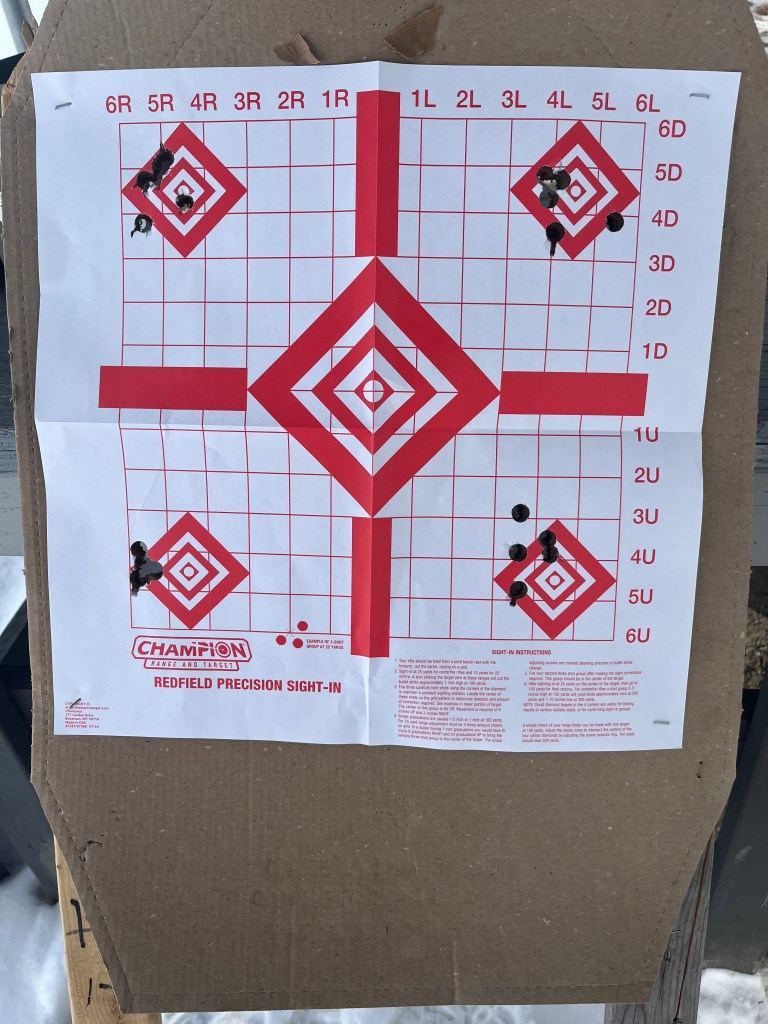
Upper left – first two rounds were touching at a quarter inch, and hitting in the same spot as before, about a half inch right and half inch high. Then, what I think is a clear flyer. Everything else is around an inch. And I think I’m at the point where the slower burning powder has no more time to combust.
But it’s been a nice test. I’ll load up a bunch of the first and take it out to distance. See if the wind affects it significantly more than the 140s.

And I still think DJT is the laser pointer president.

Rainge Day

And a minor mystery resolved.

Finished cleanup from yesterday’s projects, loaded the car and, as soon as I backed out of the garage, it poured. Well, that rarely stops me. Got to the range and half a dozen peeps were there, merrily emptying AR mags into the rain. I started setting up and, as happens once in a while, my Range Box with suppressors and Garmin Chrono were back at the house. All good, shot the breeze with my buds.

I came back later in the day, properly equipped, and shot the latest ladder:

Got a winner on the second rung at .238”! Three shots, one ragged hole.

But what the heck after that? All over the place and velocity very inconsistent. I shot a known load at the center and it landed down 5.5” at 7 o’clock. Da Fuq? Started checking for loose stuff and, damn, the can was 2 clicks loose. Tightened it, fired another known load at center and it landed properly. I think the can loosened on the second shot, upper right. First shot good, then things started dropping down and spraying. Makes sense – if the can was at all loose, the end would drop and bullets would either strike a baffle or the end cap, and hit low and slow and all over the place.

Easy to figure out after the fact. I guess I’ll redo the ladder starting from the great second rung and see what happens. That’s the fun of this game, and I already found a great 120 g load!

Ladder Load Tests Are Fun

And lets you shoot a lot, to boot.
First one got us some info – our loads are a couple hundred FPS slower than the book. It also showed us the upper end appeared to be tightening up. With that info, I did a .2 grain ladder test, starting at the last top end. So,

Yep, group gets tighter as it gets faster. Next, another .2 grain test, starting at this upper end. Since we are getting close to a compressed load, I’ll only do 3 rounds of each. Just in case I see pressure signs, need to stop, and then unload some rounds.

Tomorrow looks like a good day. With last night’s thunderstorm, I think we’ve broken the back of the hazy, hot, humid summer days. I worked outside today rebuilding porch steps, and barely broke a sweat. And now I’m sitting in my yard, overlooking the pond, and it is cool enough to keep the bugs away. I love northern NH.

Working up a load.

Yeah, that sounds sort of sus.

I have 3-4 lbs of Accurate 4350 powder. Different from Hodgdon 4350. My experience in the past is that the Accurate is definitely slower than the Hodgdon.

I also have a bunch of 6.5 Creedmoor 120 grain bullets from the time I spent figuring out my Ruger shot 140s best.

(Umm, the 0 means right on the bullet weight; the + or – means .2 grains off spec. Yes, I’m a nerd.) What to do? Load test of course.

You always start with the book. No need to reinvent the wheel.

We’ll go right by the book – 40.4 g to 43.3 – and see what we get.

Well, then. There are some possibilities. But MV is much lower than the book. Top end should be 2900; I’m only getting 2695. Between shorter barrel than the book, and lots of rounds through the rifle, it looks like I can load hotter than the book.

Tomorrow, we’ll do a .2 grain ladder test and see what we get.

Biggest Boolets for Beginners

Anything beyond these you have to enlist to get.

Yesterday we looked at that deadly midget of a round, the .223/5.56. Today let’s do a comparison with some bigger league stuff, true “high-powered” rifles. We’ll see a few more boollet types as well.

Left to right: .223/5.56 FMJ; .243 Winchester JHPBT (new – Jacketed Hollow Point Ballistic Tip); 6.5 Creedmoor JHPBT; .30 – ‘30 JSP (Jacketed Soft Point); .308 FMJ OT (Open Tip), and .30 – ‘06 FMJOT.

You can see that the itty bitty .223/5.56 is dwarfed by all the others. .30 – ‘06 was the standard American infantry round for WW I, WW II and Korea. In 1957, the 7.62 NATO/.308 was adopted by the US, first as a true assault rifle (select fire between semi and full auto) in the M-14, then as a designated marksman round. Vietnam introduced the M-16, shooting the 5.56 NATO, also select fire.

One last comparison:

.30 – ‘06 JHPOT, 30 – ‘06 M25 (Tracer), and .50 BMG (Browning Machine Gun). No, I don’t shoot .50 BMG, so I don’t have a bullet to show you. Dammit.

That’s it for Beginner Boolet Basics. Now, go shoot some of them!

Bigger Boolets for Beginners

Let’s get into the more pointy ones:

This, dear readers, is the dreaded Weapon of War Assault Rifle Boolet. It is pointy, and is (gasp!) .22 caliber*. Actual identification is 5.56 NATO, with the civilian version known as .223 Remington.

*Ok, I pulled a fast one. The Ubiquitous .22 Long Rifle is .222 inches in diameter; the almost as ubiquitous .223 Remington is .224 inches in diameter. The first is usually a 40 grain weight, while the second was originally 55 grains, but has put on weight in recent years, at 62 grains or even higher. Also, the first runs around 1100 fps while the second is around 3000 fps.

All things considered, the .223/5.56 is a tiny bullet, but it goes very fast. So, F = MV. It gets its increased F from cranking up the V. Is it a “high-powered” round? Eh, no. Its philosophy of use is “wounds pretty well” and takes combatants out of the fight. It’s also small and light so a lot of rounds can be carried. I recall that 8 standard capacity 30 round magazines is basic load out.

Back to bullet types, the military uses FMJ (Full Metal Jacket) rounds – something about some Convention in Geneva – as depicted on the left. But there are a ton of other configurations. The round on the right is FMJHP. By now you know that means Hollow Point.