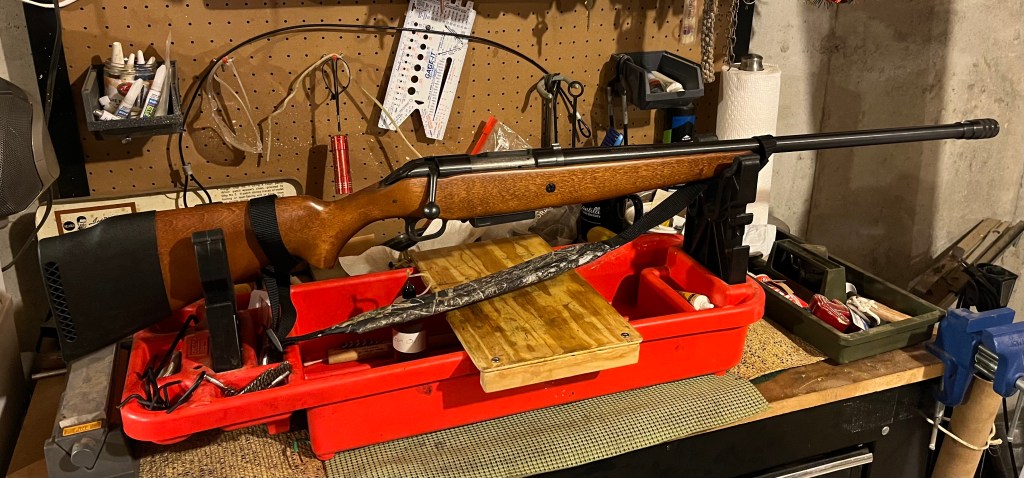
Back to the range with the Predator 6.5 and the AR-10 after their deep cleaning.
No snow!
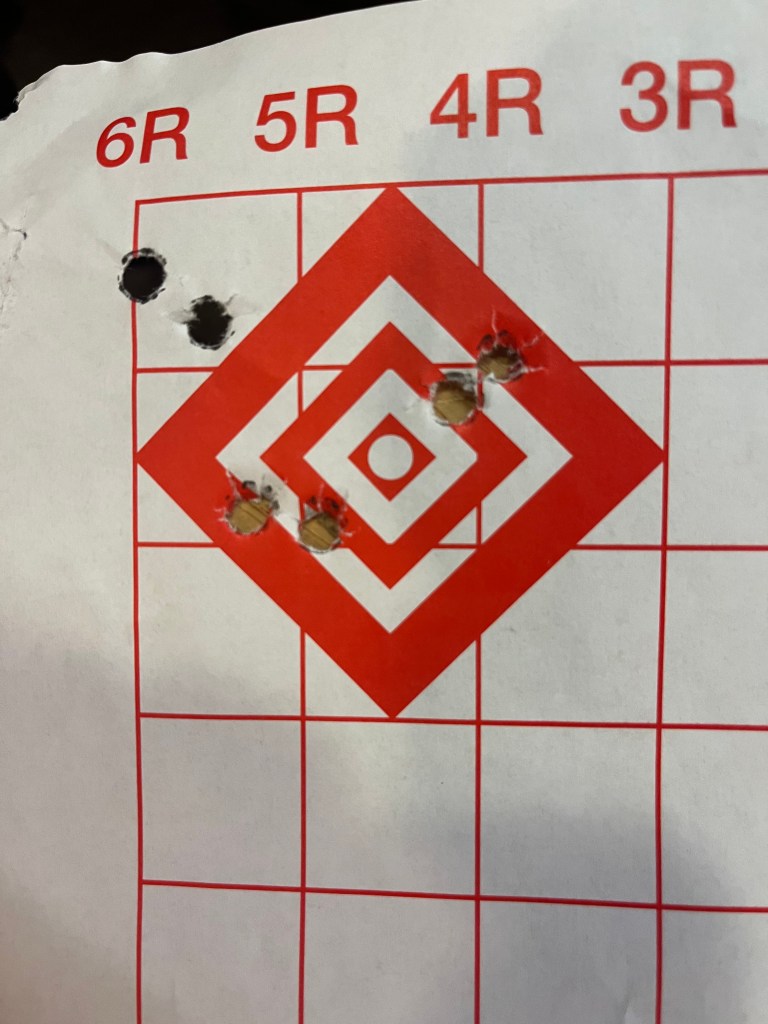
The AR loved the deep clean. First fouling/sighter shot in the center target. The next 4 were in the upper left target. But the 6.5? POA was lower left target. POI was lower right. 12 MOA to the right? No wonder I couldn’t hit anything on the Long Range last week.
I adjusted windage several times and all I got were the two on the bottom left. I loosened the windage set screws, reset them, checked out far travel on both sides and still got way left. I think my trusty Vortex Viper 6x24x50 has a problem. Over 3k rounds may have disturbed something. I contacted Vortex for the Lifetime Warranty. We shall see.
Another overnight soak, a bit more brushing and swabbing. Much cleaner.
However . . . I think all the lines ‘n stuff are machining marks. They run the length of the barrel each side of a land. The carbon sure has a place to latch onto.
But here’s an interesting pic. Inside the gas port you can see the adjustment mechanism.
So, earlier today I’m looking at these pics and Mrs. Red says, “Are those from your colonoscopy this morning?”
At a certain age the doc wants to check things under the hood. Well, more like via the tailpipe. Since I’m scheduled for one soon, it got me thinking about scopes. In this case, a borescope. I hadn’t scoped the 6.5 in a while, so I fired up my Teslong bore scope. No, not Tesla, and if anyone keys any of my stuff . . .
Anyway, I did a quick bore clean so the scope could get a good look. First thing I noticed – lots of copper on the lands. A little copper smooths out imperfections in the rifling, but too much is counterproductive.
Next, check the throat for erosion. Not much at all. What you’re seeing is the end of the chamber, the leade, and the ramping up to the rifling.
Here’s the crown at the end of the barrel:
And the blowout hole in the chamber wall:
So, best tool for the job:
WIPEOUT!!! (The Surfaris?) With Wipeout, you spray the stuff down the barrel and up the breech. It immediately foams out everywhere, which explains the paper towels.
I’m going to let it soak overnight and then do another rifleoscopy. With before and after pix, of course.
As I was falling asleep last night, I was trying to remember all of the upgrades I did to the rifle. Of course, I bedded it. Then, I
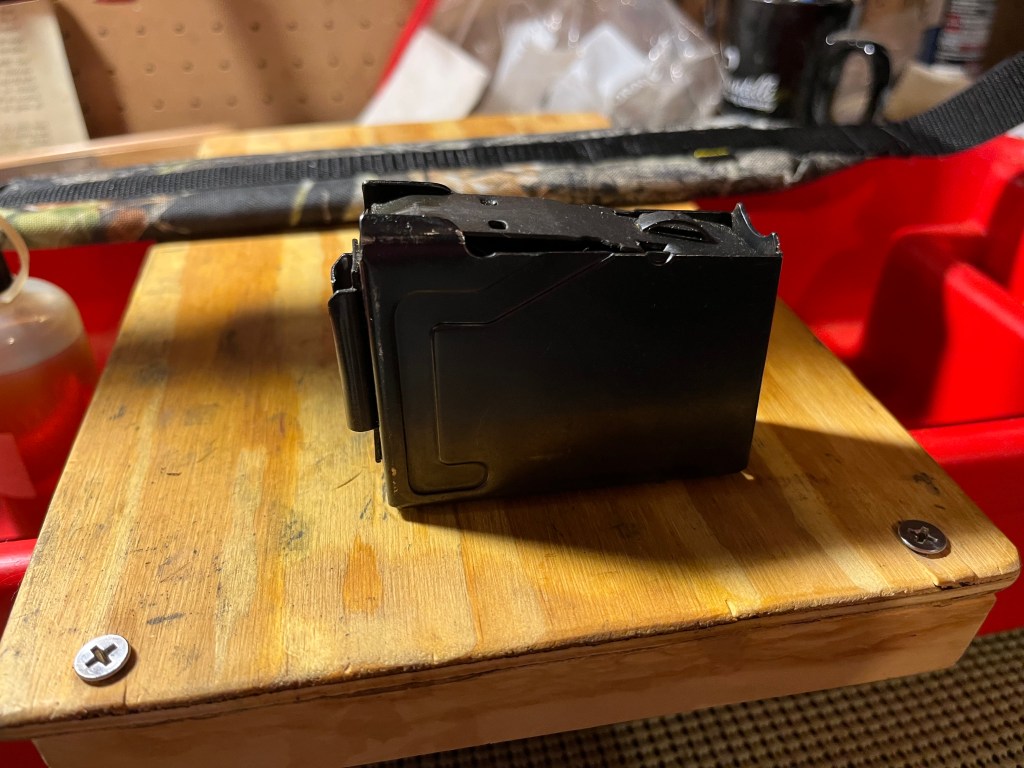
Changed out the magazine from four to AICS and ten rounds.
Adjusted the stock trigger down.
Added a muzzle brake.
Ordered a suppressor.
Received the suppressor 14 months later.
Swapped out the trigger.
I forget.
Let’s see about photos during this process:
Then I went to Texas with some shooting buddies/budettes.
I was the only one to engage the 750 target out next to the big tree. First shot left edge. Adjust. 3 good ones. A buddy knew I could shoot ok, but didn’t know how much. He brought back this pic:
I went out today to see if my 5 year old rifle with over 3000 rounds through it was still functioning. I’ll show you tomorrow.
I remember seeing the first ads come out for the 6.5 Creedmoor round in about 2008. Usually second page on the right side of American Rifleman or other magazines – the best ad placement. I didn’t pay much attention as it did not seem to be anything I needed or wanted. It looked sort of funny with all that bullet exposed, compared to sensible rounds like 5.56.
But I kept noticing it over the years, and it gained in popularity. In the 20 teens I was reloading for 5.56, .243 Winchester and .223 Winchester Super Short Magnum (that was a real barn burner at over 4,000 fps muzzle velocity. Barrel burner, too.) When I decided to reach out very long distances, the 6.5 Creedmoor seemed like the way to go.
But pricing of those rifles was just out of reach. That is, until Ruger came along. The Predator was well under a grand, and it was getting great accuracy reviews. But it had a really crappy, flimsy plastic stock and a tiny 4-round magazine. Still, it had a rep for shooting straight.
When I took mine out of the box, the first thing I noticed was that the free-floated barrel wasn’t. The right side of the fore-end was right up against the barrel. Thus began the first of many fixes/improvements/upgrades. Sandpaper took care of the first. So, how did she shoot. First shots:
Two sighters, then three vertically. OK! We can work with this. Then a dining room table picture to show 1 MOA:
And I shot Federal Premium until I had enough brass to start reloading.
Now we are cooking.
Ooh! A quarter MOA.
And at 300 yards?
Yep, fairly accurate. Tomorrow, we’ll talk about upgrades. And then maybe some long distance shooting?
Well, d’oh. You get up early in the morning and scout those little rascals and blast the heck out of them . .
Really, though, you have to get up pretty early in the morning to claim your favorite shooting table at the club. The rock solid one that gives you the best angle on those little devils. Here is the course of fire: Aspirin at 50 yards. Tums at 100. Know Your Limits steel at 150. Same at 200. .22 caliber only, but any rifle you want. Bipod and rear bag only.
10 aspirin on your individual cardboard target. One fluorescent sighter target. You may take up to 10 sighter shots, but once on the aspirin, you cannot go back. One shot per aspirin. If the round touches any part of the aspirin it is a hit. Yes, black wax streak on the side is a hit. Max score of 10.
Same thing at 100 yards with Tums. Word to the wise – this is the hardest stage.
At 150, the 5 hanging KYL targets start at 8” diameter and go down to 2.5”. You must hit each target before going on to the next. Once you hit the smallest one, you keep shooting at it.
200 yards is the same. So max score possible is 40 points. On a great day the winning score is 32-34 points. On a cold winter day in blowing snow, low 20s will win. So what rifle do you use? At least at our club, everyone started out with Ruger 10-22s, and shot CCI Standard. But is wasn’t long before ammo changed to Eley, SK, Wolf, and rifles changed to CZ, Ruger
Precision Rimfire, and the like. My own upgrades were the Christiansen Ranger and the Ruger Precision Rimfire.
Let’s take a look:
This is the best I’ve shot. 9/10. Pretty sure won that day with a 34.
Tums are tuff. At 100, wind really kicks in.
An 8 will keep you in the running.
This is what you are shooting at.
And it looks like this:
Some people say that .22 at 200 yards is similar to large caliber at 1000. I tend to agree. The .22 LR is an anemic round; it gets pushed around by the wind a lot. But it’s been around for a hundred and fifty years and is arguably the most popular caliber. It is hard to shoot well at distance.
But would you stand there and offer to be a target? I don’t think so.