But now I’m just playing.
Cats, Guns, and more. What’s not to love?

But now I’m just playing.
No, not short arms inspection.
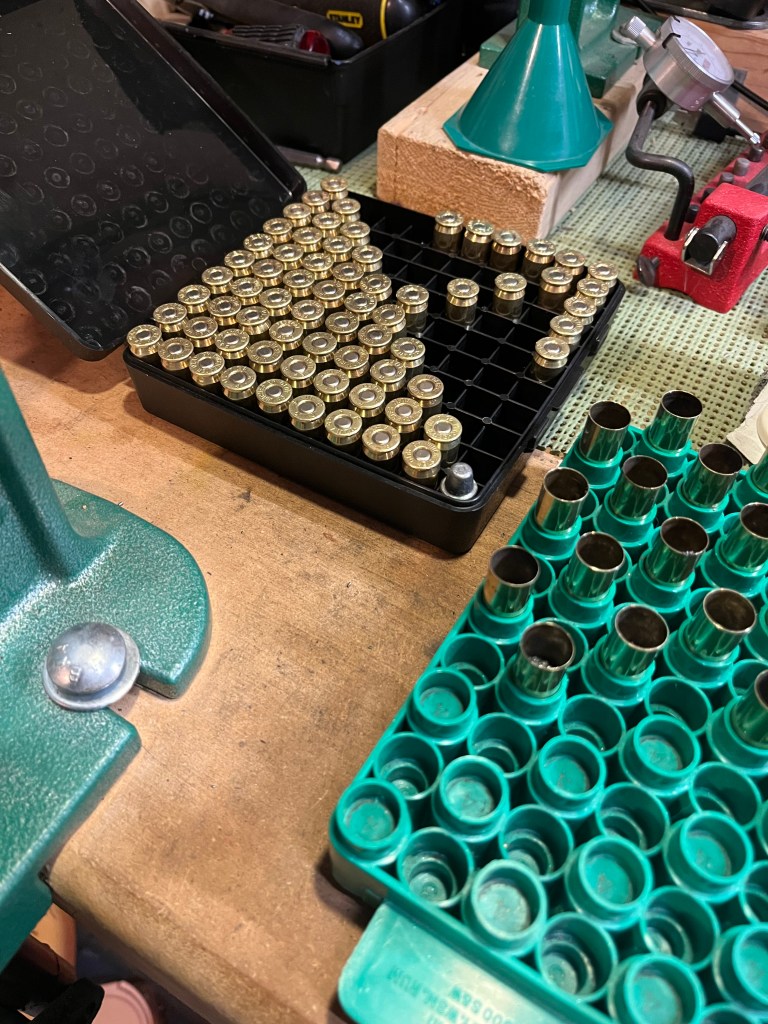
Caliber .45 Automatic Colt Pistol! I hauled out an ammo box of ten 100-rounds plastic boxes and it felt a little light. After full inventory, I discovered a shortage of 200 grain Semi-Wad-Cutters.
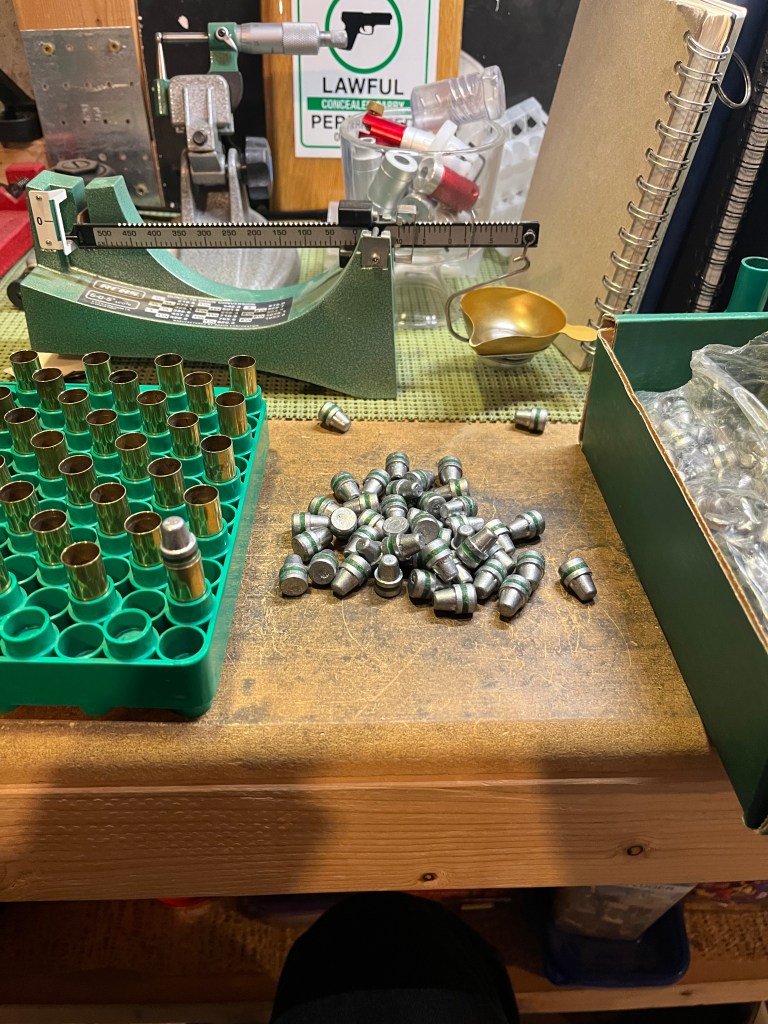
Had to switch out the bullet seater to flat nose.

Then, make sure they pass the “plonk” test.

Maybe test it tomorrow?

So how did the 156 Bergers shoot? Not bad:
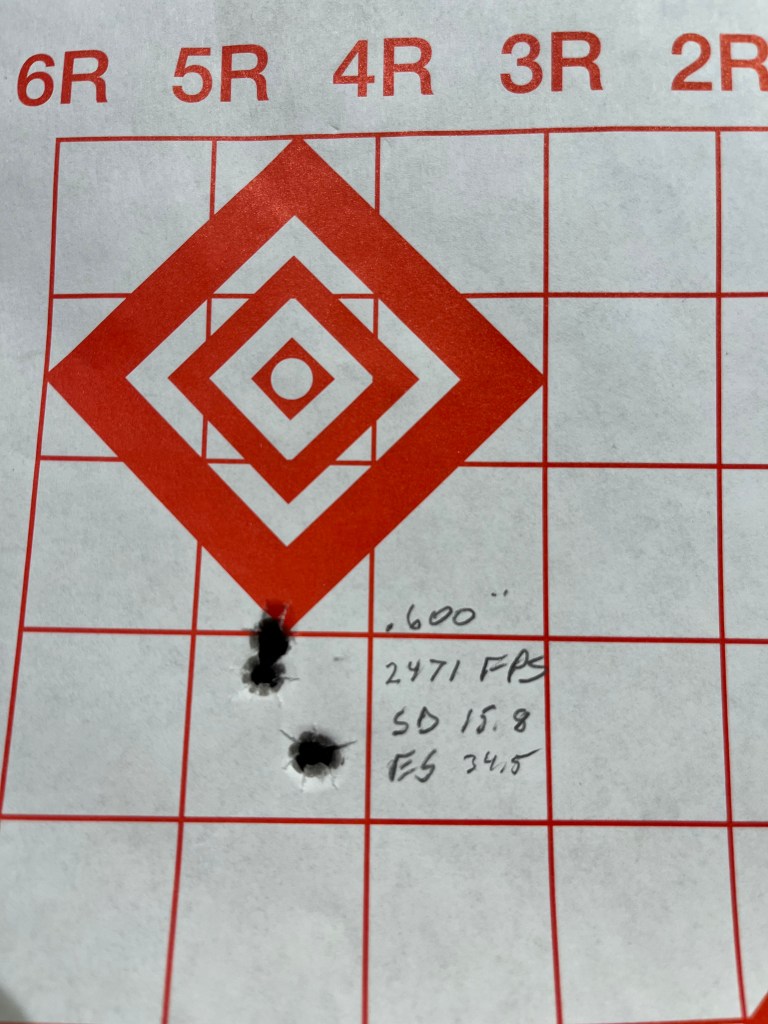
That’s 4 rounds of the 39 g. load. The 40 g. load opened up a bit, but looking at SD and ES, there was at least one bad reload.
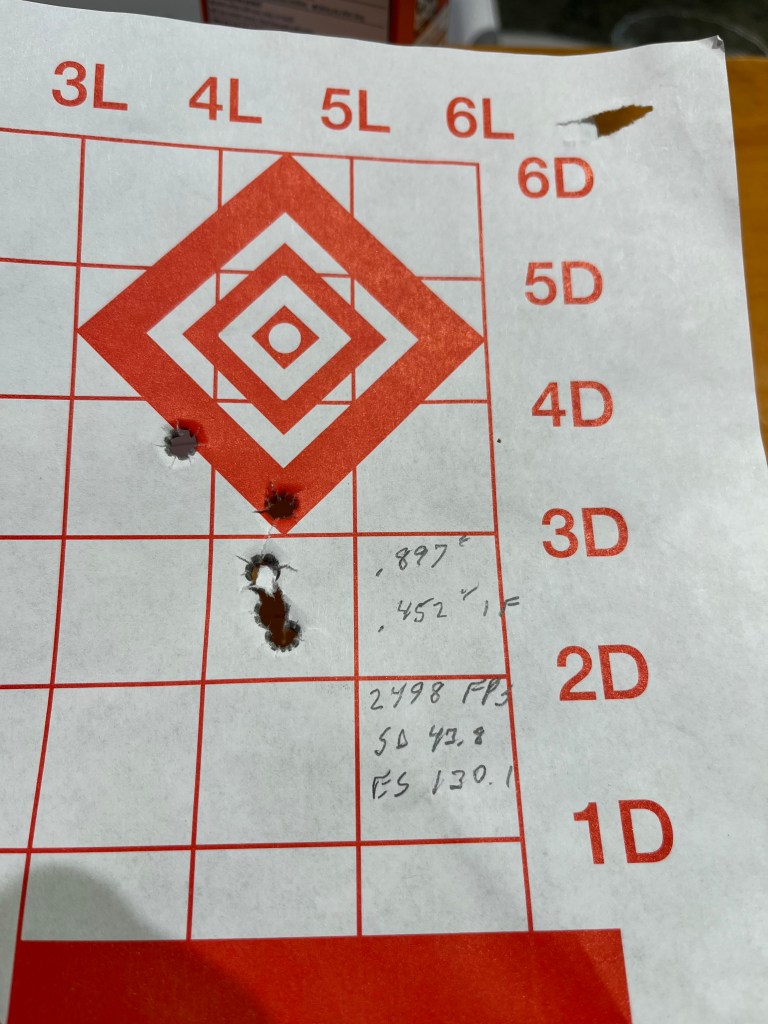
To make the point, I shot my last two rounds of it at a 300 yard silhouette:
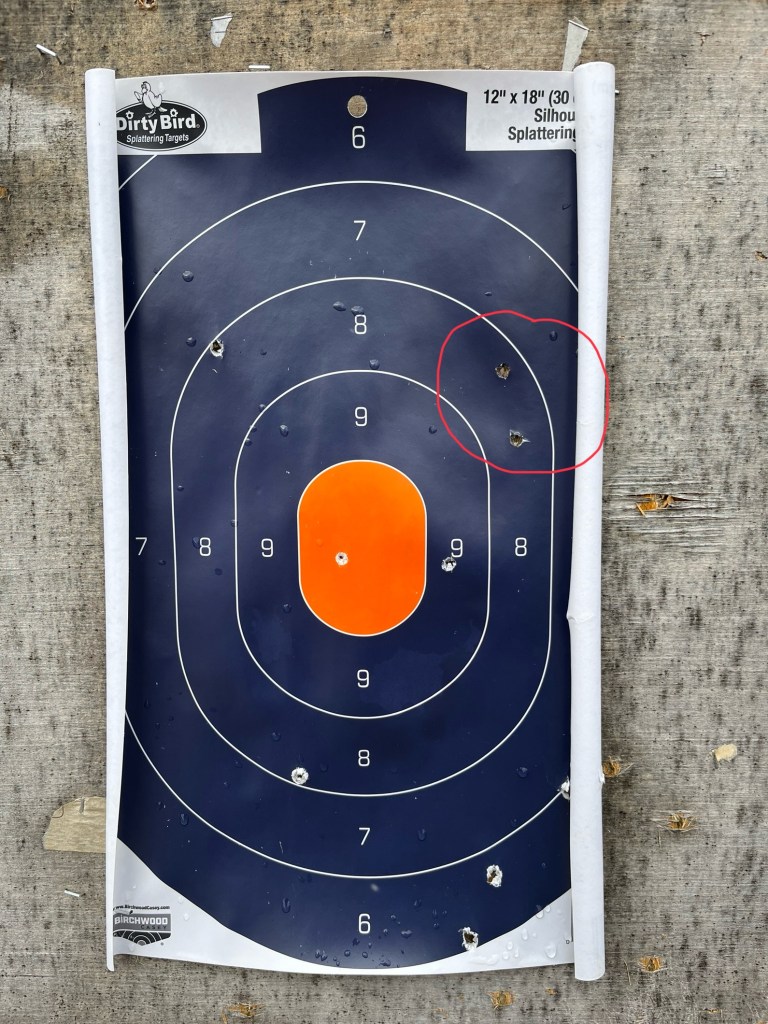
Just over an inch. I’ll take that all day long. And when I shot the Dueling tree paddles, the impact was impressive. Nothing like upping the M in the F=MA.
But the best surprise of the day was shooting some Hornady 120 ELD M I had put together a while back:

4 rounds, baby!
A few weeks back I mentioned Wadcutters as a type of bullet. I had a box of same down on the bench, old Speer with the lube wax dirty with age. I loaded some up today. The Book says they do best at 900 fps – that works out to 3.0 grains of Tite Group:

Wow. Not much compared to rifle rounds. That’s barely going to cover the bottom of this new .38 Special brass. Ripe for double or triple charge mistakes. We’ll be very sensitive to quality control.

Before and after.
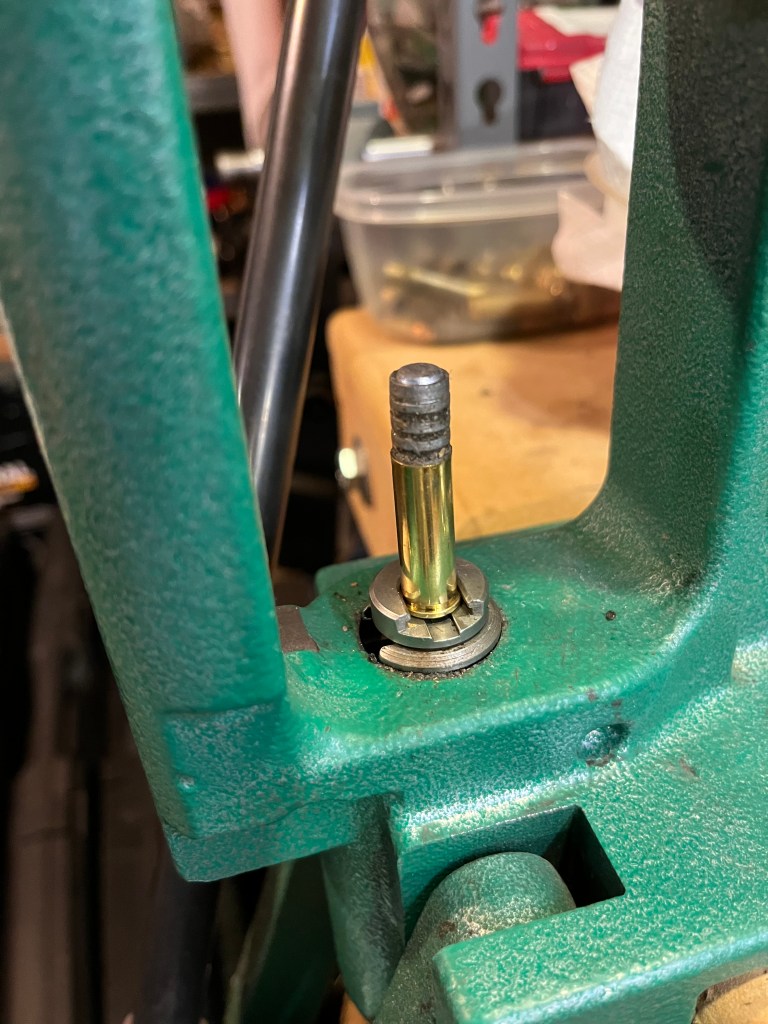
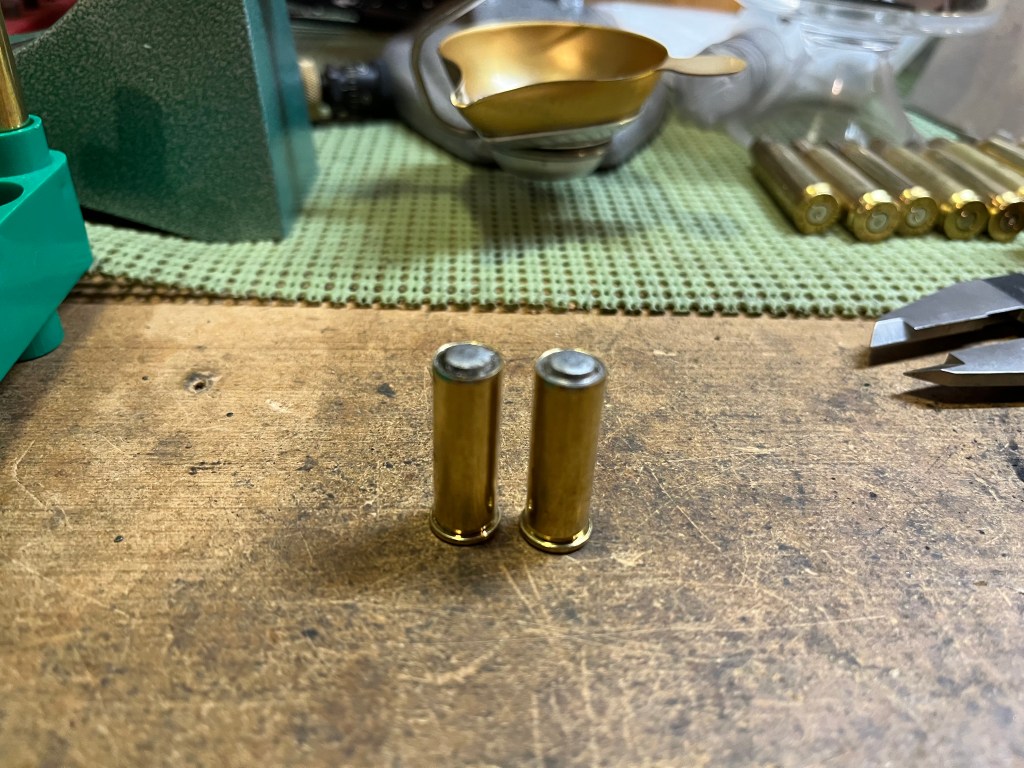
And does it punch nice clean holes in paper? Yep.

Upper left at 25 yards is 6 rounds out of the 4” barrel of the Taurus; the rest from the 2” barrel of the colt. 842 and 795 fps respectively.
It would have been nice to shoot some 3, 7, and 10 yard groups, but the Action Bays were being set up for an IDPA match.
Lessons learned? Yes, size your new brass before reloading. Pretty tight, otherwise. Live and learn.
Since my iMovie-fu is proving inadequate, let’s talk primers.

OK!
I’ve recently been using these in my cannons. And consistency has improved.
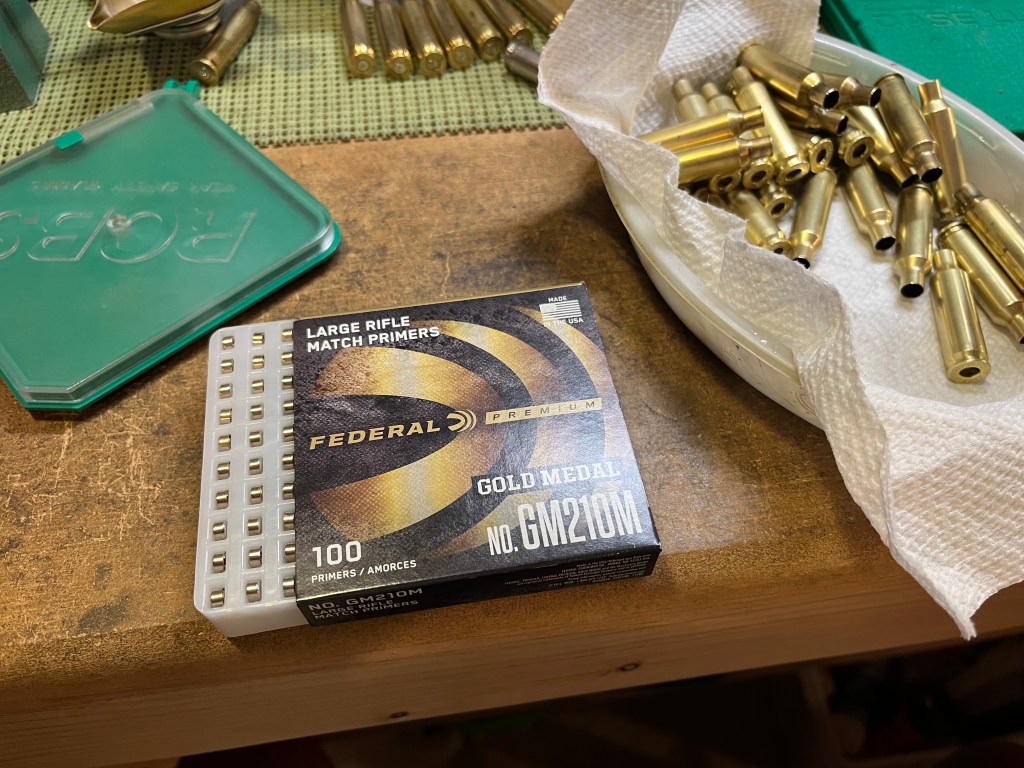
Of course, Federal Gold Medal anything seems to be top shelf.
This is about what a load of rifle powder should look like.

Well, “powder” is a misnomer. They actually are little cylindrical grains. Here’s one:
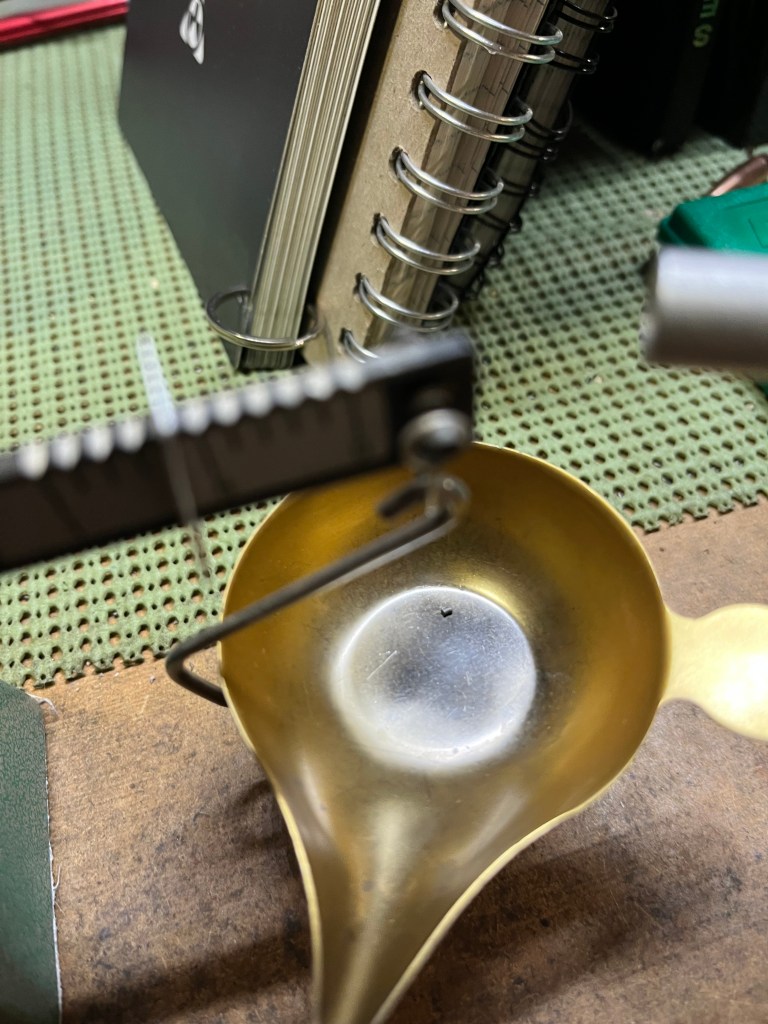
Now, serious reloaders trickle the last few of these into a case to make them all weigh the same. You measure your success with a chrono that tells you your muzzle velocity average, the standard deviation, and the extreme spread of muzzle velocity – fastest and slowest.
Standard deviation in the single digits and extreme spread in the teens is the Holy Grail – your rounds are very close to being identical.
I’ve loaded thousands of rounds and, as I trickle the last grain or two, I’ve often wondered what the difference a single grain could make. OK, yeah, very geeky.
Warning, simple math coming up.
I set my balance beam on one tenth of a Grain of powder (note weight unit versus description of a “grain” of powder). For Accurate 4350, a tenth of a Grain consists of 4 or 5 grains of powder. My best load for 120 g. 6.5 is 43.8 Grains, or 438 one tenth Grains. Multiplying that by 5 and 6 grains per tenth of a Grain gives 2190 and 2428 grains of powder per load. Dividing muzzle velocity of 2750 fps by the number of grains in a load gives 1.256 and 1.132 fps. So, every grain of powder contributes something over 1 feet per second.
Not much, huh? Ever hear of tolerance stacking? Remember, there are many other variables, such as bullet weight, case capacity, neck tension and primer capability, just as a few examples. When all those other tolerances are stacked up, that’s when you see standard deviation and extreme spread start to build.
Boy, that was geeky.
And a minor mystery resolved.

Finished cleanup from yesterday’s projects, loaded the car and, as soon as I backed out of the garage, it poured. Well, that rarely stops me. Got to the range and half a dozen peeps were there, merrily emptying AR mags into the rain. I started setting up and, as happens once in a while, my Range Box with suppressors and Garmin Chrono were back at the house. All good, shot the breeze with my buds.
I came back later in the day, properly equipped, and shot the latest ladder:

Got a winner on the second rung at .238”! Three shots, one ragged hole.
But what the heck after that? All over the place and velocity very inconsistent. I shot a known load at the center and it landed down 5.5” at 7 o’clock. Da Fuq? Started checking for loose stuff and, damn, the can was 2 clicks loose. Tightened it, fired another known load at center and it landed properly. I think the can loosened on the second shot, upper right. First shot good, then things started dropping down and spraying. Makes sense – if the can was at all loose, the end would drop and bullets would either strike a baffle or the end cap, and hit low and slow and all over the place.
Easy to figure out after the fact. I guess I’ll redo the ladder starting from the great second rung and see what happens. That’s the fun of this game, and I already found a great 120 g load!
Plenty of Kat napping lately, but not much recording.
And, oh, yeah. From yesterday, an observation. The slower moving 140 merely ripped through the target, while the faster moving 140 and 147 punched neat holes.
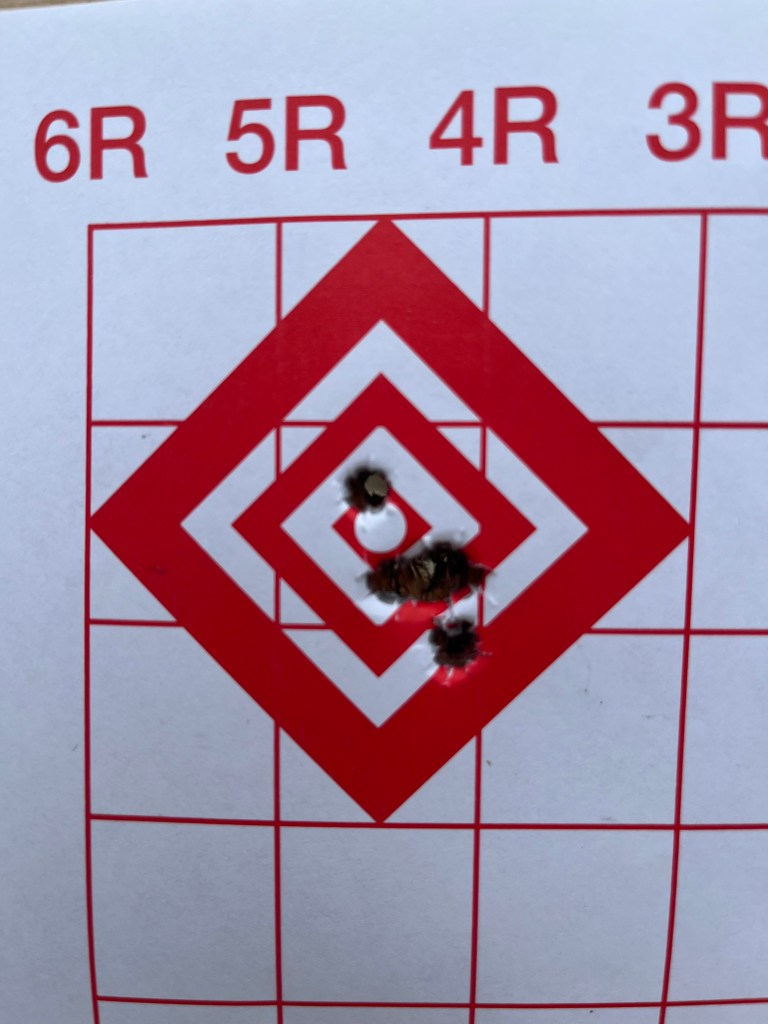


Yep. Cordless, long-distance hole punch.
And just for yucks, yesterday reorganizing my loading bench, I pulled out this:
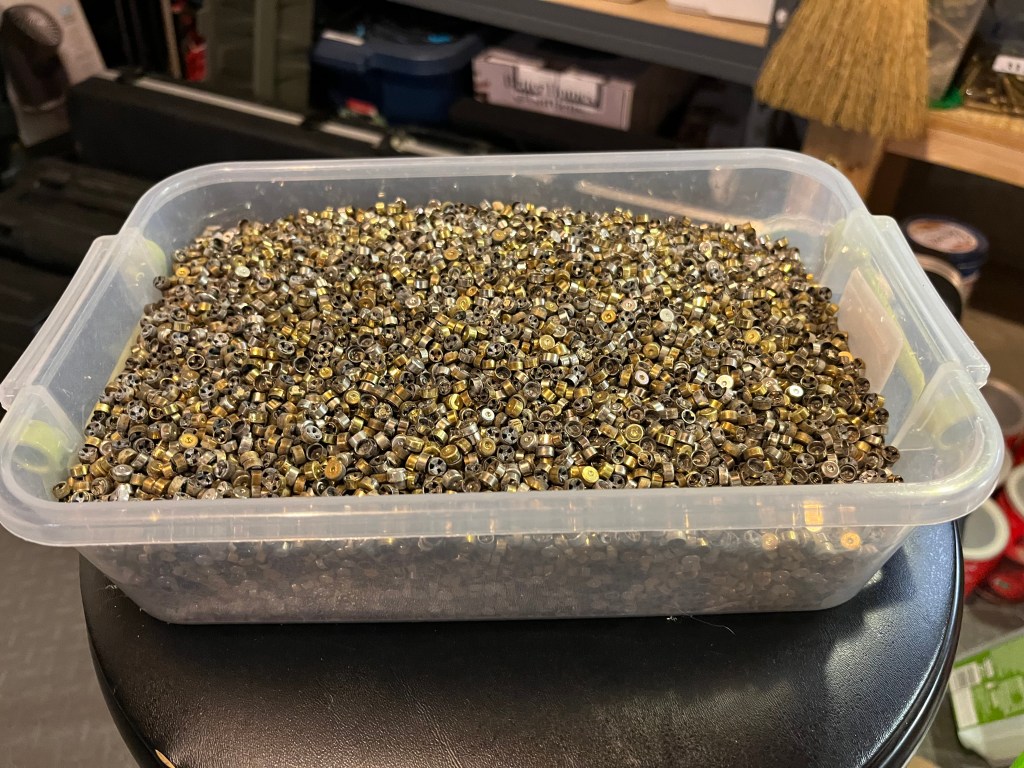
Many happy hours.
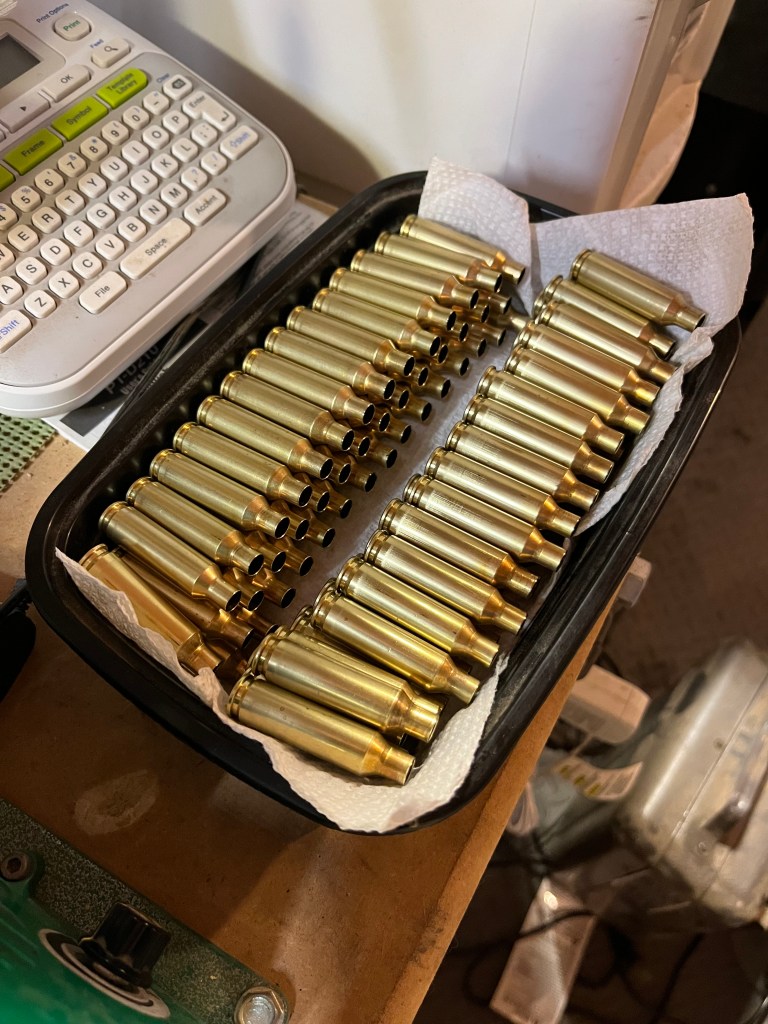
Tumbled. Check.
Annealed. Check.
Rinsed. Check.
Sized and deprimed. Check.
Trimmed, champfered, deburred, primer pocket cleaned. Check.
Primed. Check.
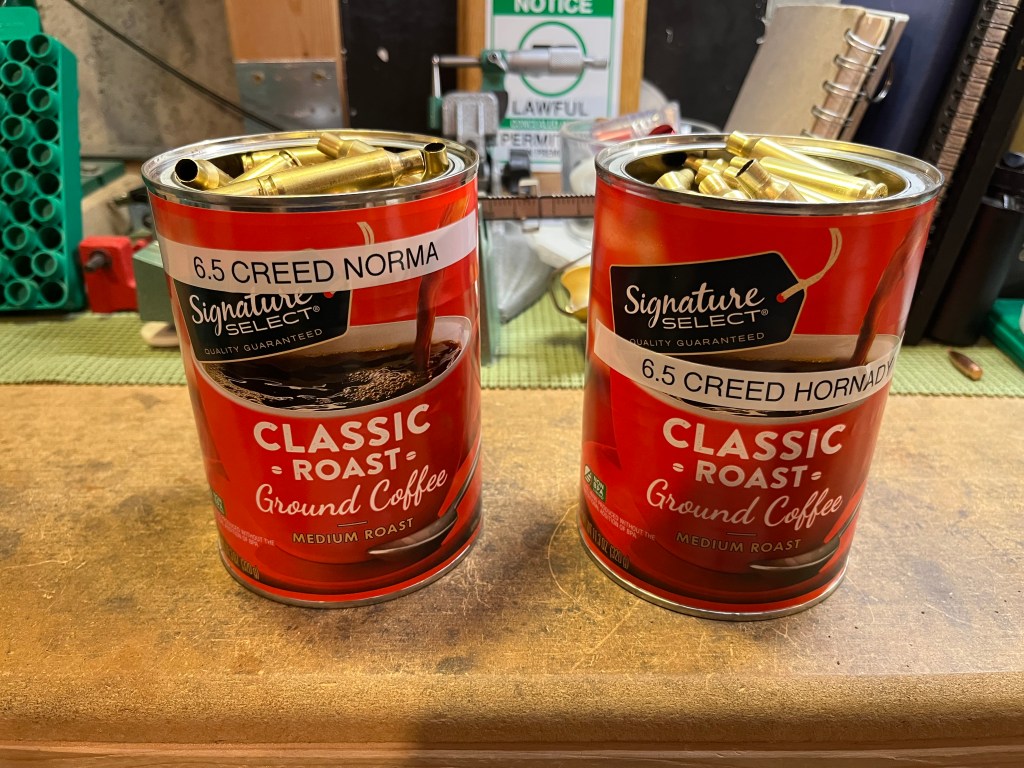
Just add powder and projectile.
Since the Vortex Viper is not back yet, I passed some time rolling some home-grown:
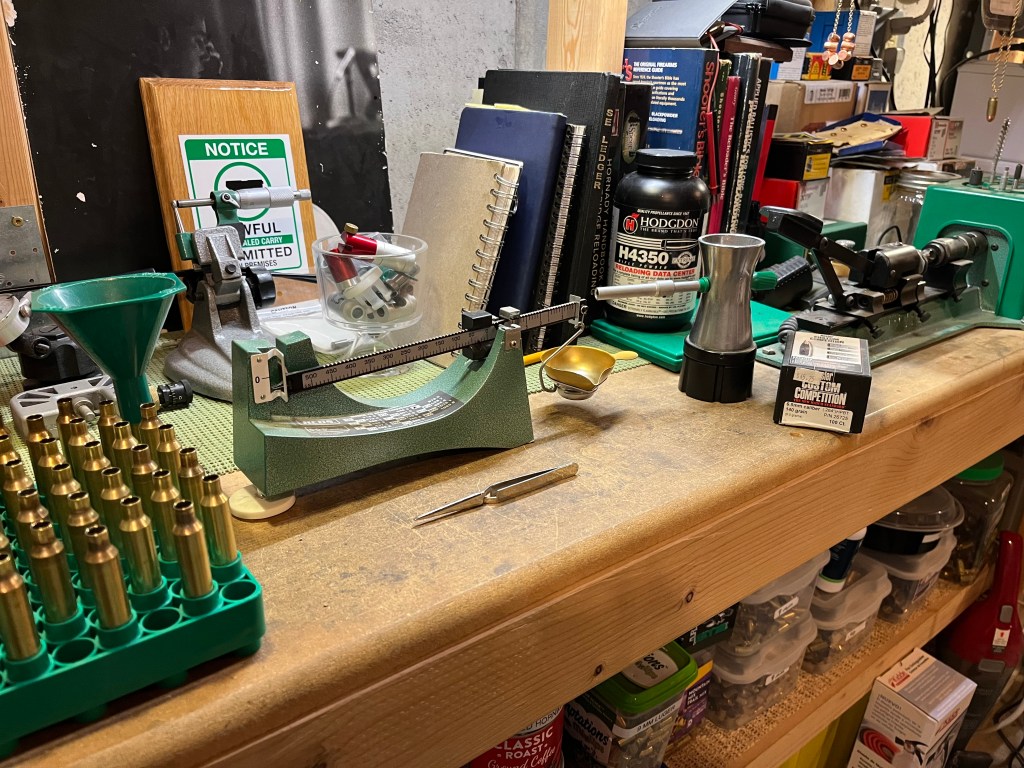
Hodgdon 4350, Nosler Custom Competition 140 g. 6.5 Creedmoor bullets.

Ain’t they just beautiful?
 KatNap Fever!