Bigger Boolets for Beginners

Let’s get into the more pointy ones:
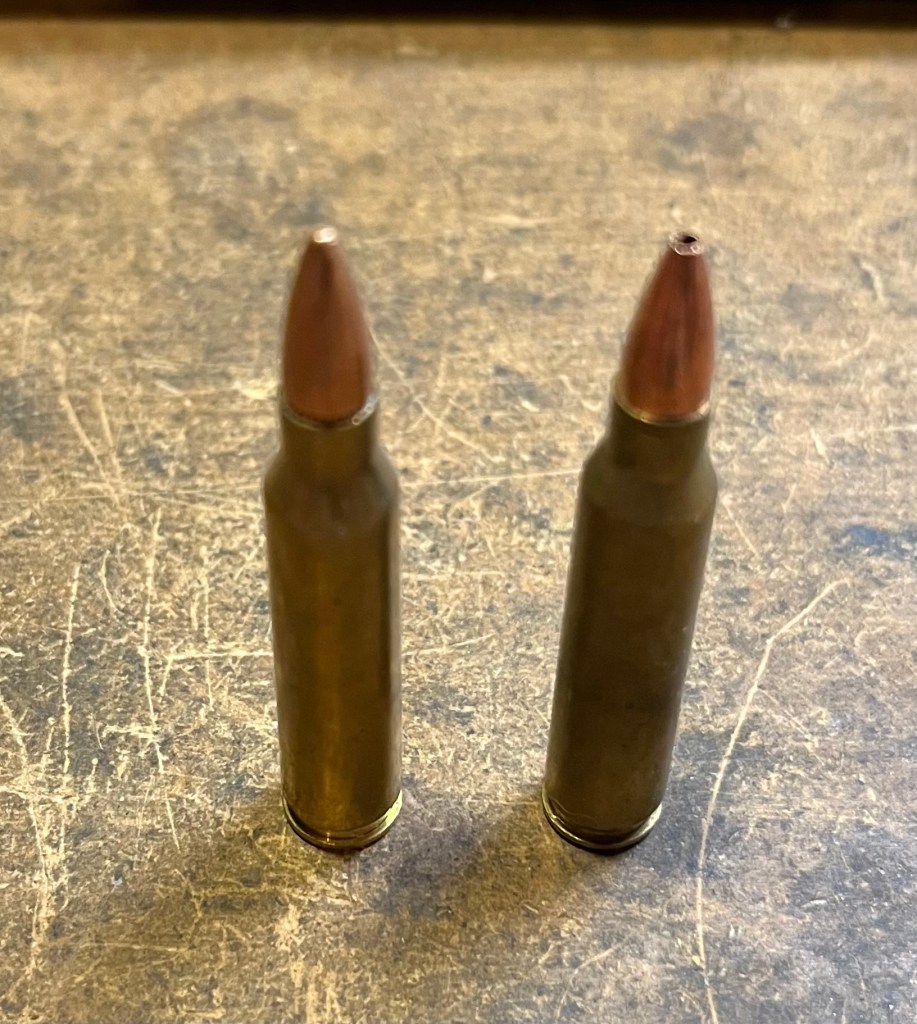
This, dear readers, is the dreaded Weapon of War Assault Rifle Boolet. It is pointy, and is (gasp!) .22 caliber*. Actual identification is 5.56 NATO, with the civilian version known as .223 Remington.

*Ok, I pulled a fast one. The Ubiquitous .22 Long Rifle is .222 inches in diameter; the almost as ubiquitous .223 Remington is .224 inches in diameter. The first is usually a 40 grain weight, while the second was originally 55 grains, but has put on weight in recent years, at 62 grains or even higher. Also, the first runs around 1100 fps while the second is around 3000 fps.

All things considered, the .223/5.56 is a tiny bullet, but it goes very fast. So, F = MV. It gets its increased F from cranking up the V. Is it a “high-powered” round? Eh, no. Its philosophy of use is “wounds pretty well” and takes combatants out of the fight. It’s also small and light so a lot of rounds can be carried. I recall that 8 standard capacity 30 round magazines is basic load out.

Back to bullet types, the military uses FMJ (Full Metal Jacket) rounds – something about some Convention in Geneva – as depicted on the left. But there are a ton of other configurations. The round on the right is FMJHP. By now you know that means Hollow Point.
Moar Big, Beautiful Boolets.

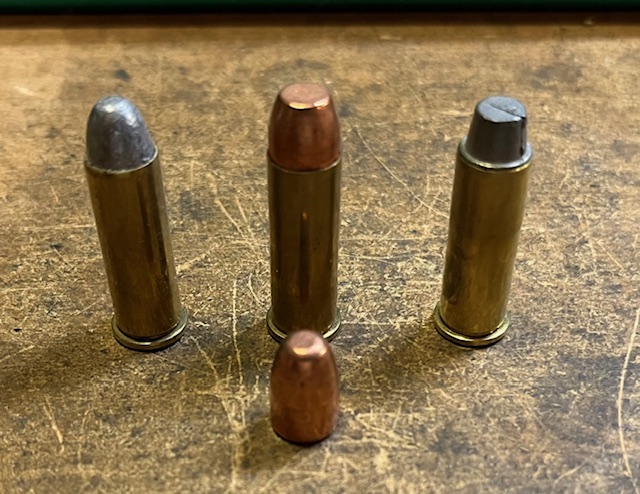
Let’s take a look at some traditional golden oldies. .38 Special has been around since 1898. Here are some different assorted Freedom Pills:

Left to right: LRN – Lead Round Nose. FN FMJ – Flat Nose Full Metal Jacket, with the more traditional RN FMJ – Round Nose Full Metal Jacket- in front. Then LSMWC – Lead Semi Wad Cutter.

So, some new concepts. Flat nose bullets do a couple of things – they make a nice neat hole in paper instead of the sometimes ragged one that round nose bullets make. They also can fit into slightly smaller sized magazines. I’m thinking specifically of .357 Sig, which shoots a flat nosed .355” bullet out of a necked-down .40 Smith & Wesson cartridge. Both .357 and .40 rounds are flat nose and fit the same magazine.

Next new term: what the heck is a “wad cutter”? Imagine shooting a bullet through a phone book (oops, later generations may have to Gurgle that term). A wad cutter neatly cuts a wad of paper. It leaves a very clean hole in paper targets and, lore has it from older cops, people targets. Pictured above is a Semi Wad cutter because it actually has a bit of a bullet nose on it. Below is an actual Wad Cutter with a standard round nose bullet for comparison:

Wait till you see the next round (hah!) of bullet choices!

Boolets for Bangstick Beginners

Just thinking, we’ve talked a lot about bullet propellers, but vary little about bullet projectiles. Let’s take a look:

  1. This is where the magic fairy dust is located. On .22s, it’s in the rim. On center-fires, it’s in … the center. When something strikes (a firing pin or a “striker”) the primer in which the magic fairy dust is located, it makes intense fairy dust fire. In fact, this is the only part of the boolet that is “explosive “.
  2. This is the Freedom Powder holder. It is made of brass (because manly things, such as “brass balls”, are made of brass). And even better, they can be recycled into more Freedom Powder holders!
  3. Freedom Powder, when ignited by the Fairy Dust fire, seeks to be free. Because everything in life does. It very quickly seeks freedom. In fact, it expands so quickly that things in its way will also seek freedom.
  4. The Boolet. Also known as the Freedom Seed. The Freedom Powder sends it on its merry way.

But Mr. KatNap Fever guy, I see boolets with all different shapes, sizes and headgear. What gives?

Well, dear reader and Beginning Bangstick Boolet connoisseur, this is where, truly, Diversity Is Our Strength. I shall start explaining soon. As soon as the wonderous, glorious Big, Beautiful, Fourth of July weekend is over.