Got a lot to see here. For comparison, on the left, a simple 9 mm RN FMJ (remember, Round Nose Full Metal Jacket). Next, a .357 Sig FN FMJ – Flat Nose FMJ. Then, a .357 Sig JSP – Jacketed Soft Point. A .357 JHP – Jacketed Hollow Point. A .40 S&W FN FMJ – Flat Nose Full Metal Jacket. And finally, a .40 S&W JHP – Jacketed Hollow Point.
Do you begin to see the notation now?
Apropos of nothing, when I took this pic yesterday, it prompted me to change my G 32 from 9 mm back to .357 Sig. Quick barrel and mag swap, and I aired it out at the range today. It’s a shame that .357 Sig did not catch on. For a while, the US Secret Service, and a number of State Highway Patrols used it (great vehicle penetration, I’m told). But the ammo is about twice the price of 9 mm, with the necked down case, it’s more difficult to reload, and it definitely has a blast factor. But when you shoot it, you know that it is a brass balls manly round.
Let’s look at an initial comparison between .380 ACP, 9 mm Luger, and .357 Sig.
Federal 95 grain FMJ .380 being fired from a 3.75” barrel at 980 fps – 203 foot-pounds of energy.
Federal 115 grain FMJ 9 mm being fired from a 4” barrel at 1180 FPS – 355 foot-pounds of energy.
Federal 125 grain FMJ .357 Sig being fired from a 4.5” barrel at 1350 FPS – 506 foot-pounds of energy.
There’s a good article over at TheGunZone.com from May 2024 that stresses that foot-pounds is not the be all and end all. Bullet design, expansion, shot placement and bullet weight all are equally as important. As a general comparison, it does give some idea of effectiveness, though. With the above numbers, the comparison is just as you would expect.
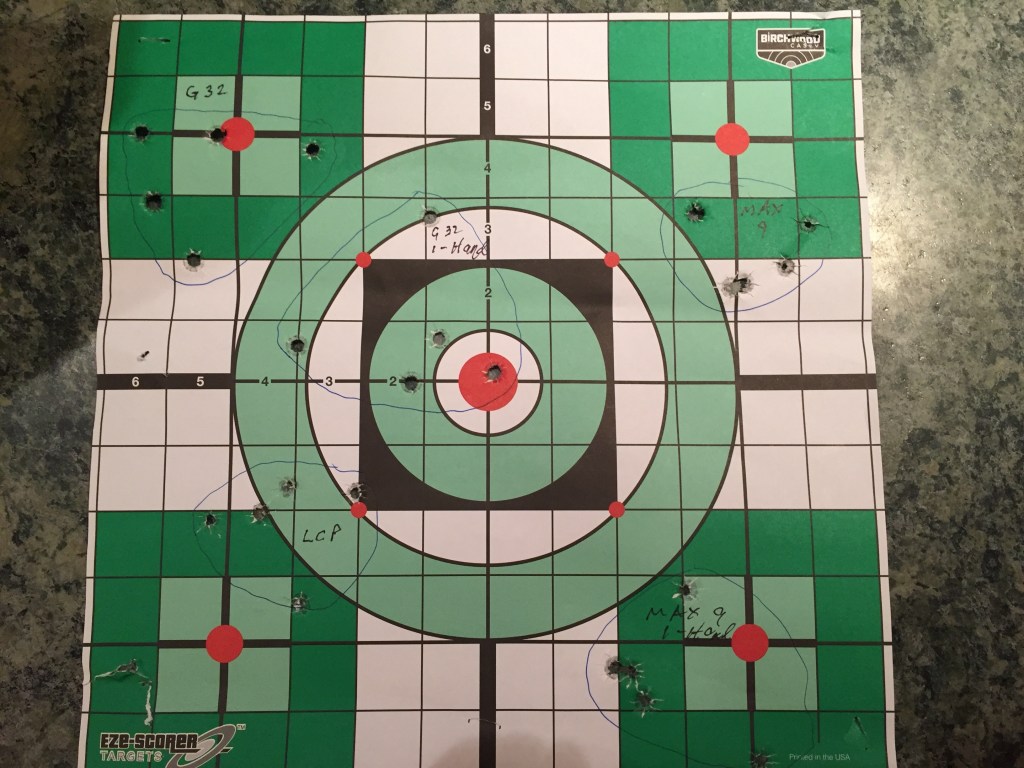
So let’s assume that each bullet is designed properly – I’d say shot placement is the most important. Can I quickly shoot each at Tueller Drill distance of 7 yards with a two-hand grip and make the hits count? Can I do it shooting dominant hand alone? Let’s take a look:
Looks like both the Max 9 and the LCP group around 2”, while the G32 spreads out a bit.
What’s the takeaway, then? For a tiny mouse gun the LCP shoots accurately enough (although in a sudden unexpected defensive gun use situation, I’d bet that grappling distance is more likely than 7 yards. I think Heinlein described it as “bad breath” distance). Proper bullet design, expansion and 200 foot-pounds of energy should be ok.
Same thing with the Max 9, but twice as many rounds and more foot-pounds.
The Glock? If I am knowingly going into a firefight, lots of bullets and lots of energy. But the final consideration is “which one am I likely to have with me all of the time?”
In real life, I’m a belt and suspenders guy. The LCP is with me always. One of the other two is usually with me as well, depending on season, clothing and perceived threat level. So the answer to the initial question, “How compact is compact?”, is, in my case, small enough to carry concealed.
I’d need to put some height and weight on to carry a 1911 daily. Maybe take a look at the legendary .45 ACP soon.
Well, from yesterday’s bullets, anything shooting them should be compact, right? Mmmm, no. From left to right, .380 ACP, 9 mm Luger, and .357 Sig. They do all share the same actual diameter – .355 inches. Yep, don’t rely on bullet names to accurately represent dimensions; there’s usually a bunch of marketing in the name. .357 Sig was meant to match the stopping power and name recognition of the .357 Magnum, but shoot out of an autoloader instead of a revolver. And the European name of the .380 is the 9mm Kurz, Kurz being Short in German.
So what size compacts will shoot these rounds?
,
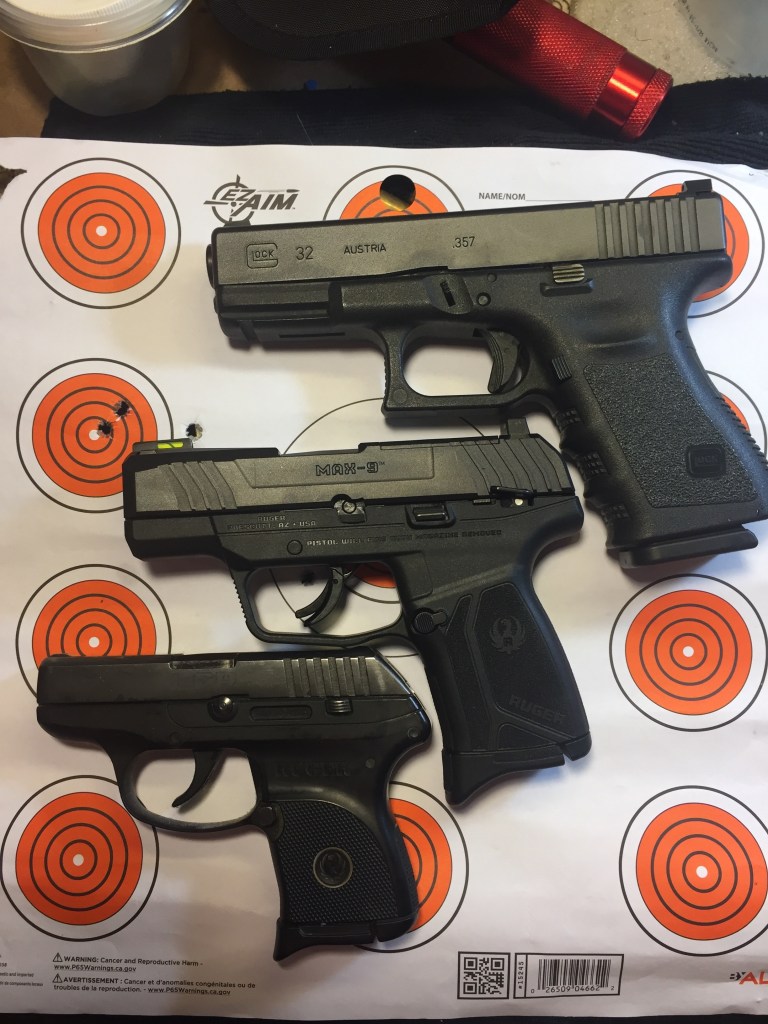
Top is the Glock 32 (but it’s really the G19, which is the compact version of the original plastic fantastic Glock 17). The 19, 23 and 32 are the exact same frame, but calibered in 9 MM, 40 S&W, and Sig .357 respectively. Swap out the barrels and they are virtually interchangeable. Minor quibble, the 40 and 357 use identical magazines, while the 9 uses its own.
So, the G32 above, marketed as a compact, can shoot the barn-burning .357 Sig, as well as the 40 “Short & Weak” and the 9 mm “EuroPellet”.
Next pistol down is a Ruger Max 9. It is chambered in, you guessed it, 9 mm. But it is significantly smaller than the Glock. Maybe we can call it a Sub Compact.
And finally, the Ruger LCP. Little Compact Pistol? Perhaps we are talking Micro Compact. And it is significantly smaller than the Max 9. I’m betting it will fit in a pants pocket easily.
Tomorrow, let’s compare dimensions, performance, accuracy and some other factors. But all shooting the same diameter bullet should make it easy. Right?


 KatNap Fever!