Biggest Boolets for Beginners

Anything beyond these you have to enlist to get.

Yesterday we looked at that deadly midget of a round, the .223/5.56. Today let’s do a comparison with some bigger league stuff, true “high-powered” rifles. We’ll see a few more boollet types as well.

Left to right: .223/5.56 FMJ; .243 Winchester JHPBT (new – Jacketed Hollow Point Ballistic Tip); 6.5 Creedmoor JHPBT; .30 – ‘30 JSP (Jacketed Soft Point); .308 FMJ OT (Open Tip), and .30 – ‘06 FMJOT.

You can see that the itty bitty .223/5.56 is dwarfed by all the others. .30 – ‘06 was the standard American infantry round for WW I, WW II and Korea. In 1957, the 7.62 NATO/.308 was adopted by the US, first as a true assault rifle (select fire between semi and full auto) in the M-14, then as a designated marksman round. Vietnam introduced the M-16, shooting the 5.56 NATO, also select fire.

One last comparison:
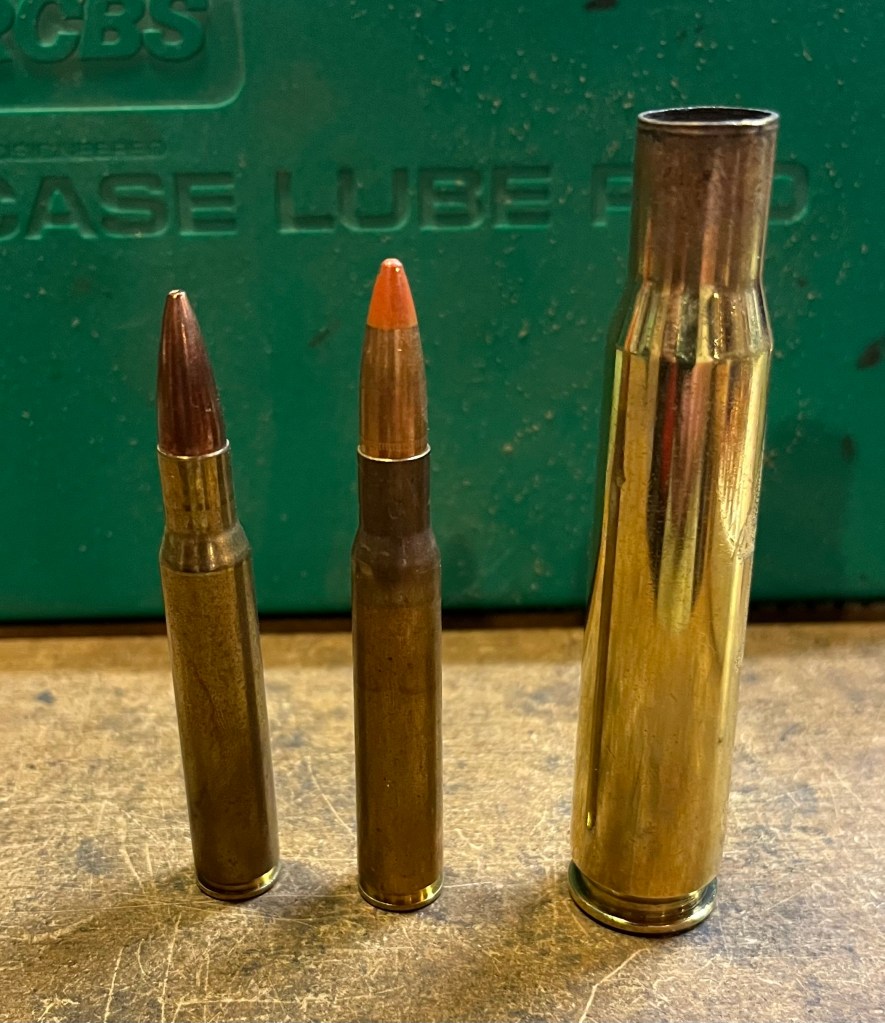
.30 – ‘06 JHPOT, 30 – ‘06 M25 (Tracer), and .50 BMG (Browning Machine Gun). No, I don’t shoot .50 BMG, so I don’t have a bullet to show you. Dammit.

That’s it for Beginner Boolet Basics. Now, go shoot some of them!
Bigger Boolets for Beginners

Let’s get into the more pointy ones:

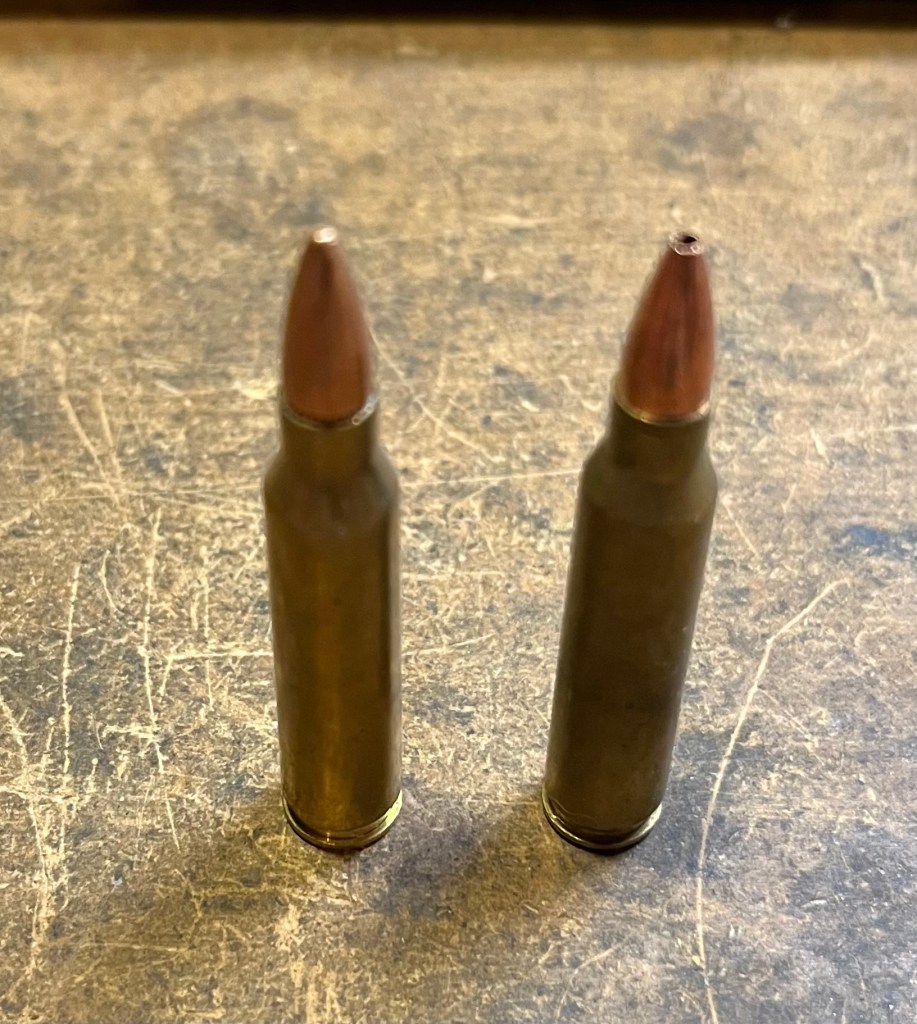
This, dear readers, is the dreaded Weapon of War Assault Rifle Boolet. It is pointy, and is (gasp!) .22 caliber*. Actual identification is 5.56 NATO, with the civilian version known as .223 Remington.

*Ok, I pulled a fast one. The Ubiquitous .22 Long Rifle is .222 inches in diameter; the almost as ubiquitous .223 Remington is .224 inches in diameter. The first is usually a 40 grain weight, while the second was originally 55 grains, but has put on weight in recent years, at 62 grains or even higher. Also, the first runs around 1100 fps while the second is around 3000 fps.

All things considered, the .223/5.56 is a tiny bullet, but it goes very fast. So, F = MV. It gets its increased F from cranking up the V. Is it a “high-powered” round? Eh, no. Its philosophy of use is “wounds pretty well” and takes combatants out of the fight. It’s also small and light so a lot of rounds can be carried. I recall that 8 standard capacity 30 round magazines is basic load out.

Back to bullet types, the military uses FMJ (Full Metal Jacket) rounds – something about some Convention in Geneva – as depicted on the left. But there are a ton of other configurations. The round on the right is FMJHP. By now you know that means Hollow Point.